Leipzig is located in eastern Germany, in the state of Saxony, just over an hour by train from Berlin. The city’s name is often associated with Bach, the Gewandhausorchester, the Leipzig New School or the Nikolaikirche, where the peace prayers of 1989 helped open a decisive rift in the German Democratic Republic (GDR). For the cultural traveler, its appeal lies in another nuance: it concentrates a dense history without the tourist saturation of the most obvious German cities.
A tour of the city allows you to get closer to a cultural scene with its own identity, not derived from Berlin and that has its own complexity. Here, Napoleon, Mendelssohn and Goethe strolled through its cafes and passages. Currently, the atmosphere is that of a university city that fights against gentrification and the challenges left by German reunification. I spent a few days there as a gateway to a tour of Saxony, learning about the history of this region, and these are some of the reasons I found to include it in a route that seeks culture, gastronomy, art and more.
Plagwitz from the water
The Plagwitz canals cross the west of the city with a navigable network of nearly two hundred kilometers. On good weather days they are filled with kayaks and small boats; That Sunday, in the rain, we left on a boat with about ten people on board: six journalists and some local tourism representatives who accompanied us during the trip, helping us to have a more complete narrative sequence of the different moments that have marked the history of the region. The tour lasted an hour or so and was enough to see a different Leipzig than the one you imagine from its churches and concert halls.
The bridges were so low that we had to duck to go under them. On each side passed historic houses that were built with the promise of lasting love, graffiti, residential sections and factories that still mark the landscape. Jan Benzien, former Olympic canoe slalom athlete and now director of Stadthafen Leipzig (the city’s port), met with us and told us that the new port will be completed in just a few months, and that he seeks to turn the canals into one of the most interesting entrances to Leipzig during the spring and summer.
Plagwitz has had that logic for a long time. In the 19th century, businessman Carl Erdmann Heine promoted industrial planning in this western neighborhood with factories, canals, workers’ homes and transportation routes. The predominant channel is named after him. Today, red brick, large patios and chimneys continue to mark the urban fabric.
There is a lot of enthusiasm for this tourism project and, on days with better weather, the new port will offer a meeting point with its restaurants and rental of kayaks and small boats to explore the canals.
An active factory with a Niemeyer sphere
A short distance from the canals is Techne Kirow, heir to Kirow Ardelt, a company specializing in heavy railway cranes. Johannes Roewe, director of the company, accompanied us that Sunday around the complex for a tour of the production halls. Being the weekend, the factory was empty but that didn’t make it any less interesting. The metal parts, overhead cranes and finished equipment sat in their places silently. On a long-established day, Roewe said, the traveler may encounter workers eating in the tavern along with company workers, artists and visitors to the Spinnerei.
Roewe told the story of this company through the German 20th century. It started as private property. It passed into state hands during the GDR. It was privatized again after reunification. Today it operates with clients on several continents and manufactures gigantic cranes that intervene when a train derails or when a railway operation requires extreme precision. It is a niche industry, with all the technical weight that this implies and which is a sample of German precision and engineering.
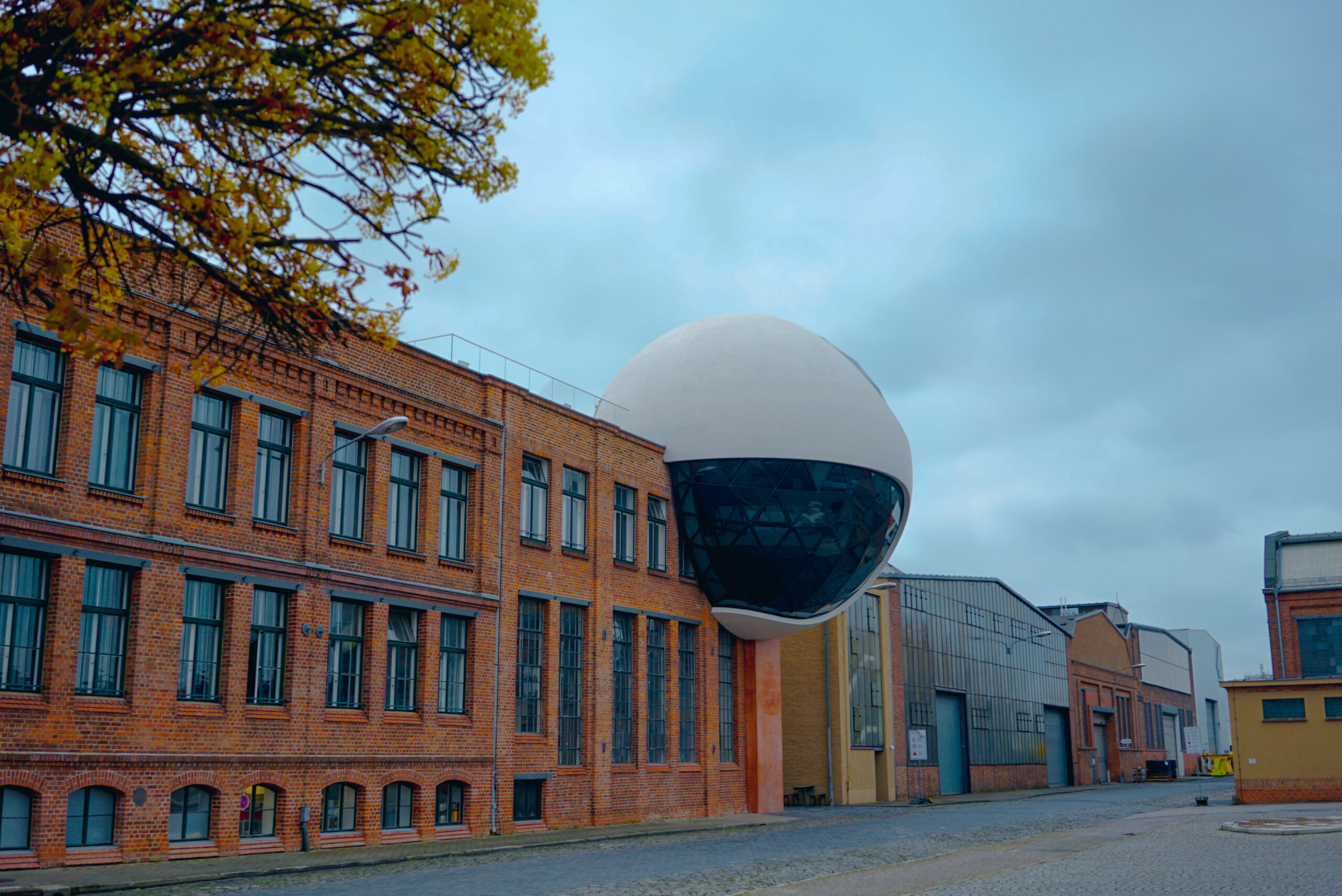
In one of the patios, just to one side of the industrial warehouses, an unexpected image appears: a white sphere twelve meters in diameter designed by Oscar Niemeyer. The Brazilian architect drew it on his one hundred and fourth birthday, in December 2011. He died the following year. His collaborator Jair Valera developed the project and the structure was completed in 2020, on the old factory canteen. Today it functions as a cafe, restaurant and event space.
Entering changes the reading of the building. From inside, through the curved glass, you can see the industrial buildings and the factory as if in an involuntary frame: red brick, chimneys, assembly halls. The structure is futuristic. From inside, he looks back at the galleries and the red brick of the neighborhood.
The Spinnerei: one of the most important meeting points for German contemporary art
A few minutes from Techne Kirow is the Leipziger Baumwollspinnerei. Until 1992 it was the largest cotton spinning mill in continental Europe. When production closed, the brick complex became available at low rents. The first to arrive were artists. Neo Rauch, one of the most important German painters of today, set up his studio there and became associated with the nucleus of the Neue Leipziger Schule, the New School of Leipzig, a generation formed around the Higher School of Graphic and Book Arts that projected the city into the international circuit of contemporary art.
The Spinnerei today has more than one hundred active workshops, as well as galleries, a cinema, a theater, an artist’s book publishing house, printing workshops and Halle 14, a non-profit space that articulates part of the collective programming. For a traveler with an interest in contemporary art, the complex will be of great interest: you can spend an entire morning there, with galleries open to the public and workshops occasionally accessible.
The process preserves tensions that are worth knowing. In the same neighborhood, at Halle 14, SpinLab, the HHL Leipzig startup accelerator, operates. Cultural and democratic initiatives linked to rural areas of Saxony have also emerged from the same environment, a region where the advance of the AfD, a far-right party that has gained support in recent years, has reduced the scope for independent activism. The generation that reactivated the complex thirty years ago today sees Plagwitz as a consolidated neighborhood. The younger scene moves towards Eisenbahnstraße, a multicultural and working-class area where rents still allow for workshops. Eisenbahnstraße thus appears as a clue for anyone who wants to follow Leipzig’s younger creative scene.
Connewitz and the night in the anti-fascist neighborhoods of Leipzig
In order to understand the contemporary culture of Leipzig, I dedicated a night to explore Connewitz.
On Saturday night, when I arrived in Leipzig, I left alone the resort where I was staying in the historic city center a few blocks from Marktplatz and took the tram south. The journey, which lasted about twenty minutes, allowed me to see how Leipzig was becoming quieter. The streets around Conne Island were dimly lit but didn’t feel threatening. I had dinner earlier in a small Pakistani restaurant on Wolfgang-Heinze-Strasse.
Conne Island is at the end of a side street. A huge graffiti with the word Antifa, painted on one of the walls next to the club, gave the political tone. Saturday’s poster announced Song for human of uswith Gelbes Pep aus Düsseldorf, Das Kinn and Gewalt. It was dark inside. It sounded post-punk with industrial textures behind it. There were between two and three hundred people, most of them young, university students, dressed in black. The noise of conversations competed with the bands. Outside, others were playing basketball, smoking, drinking beer or continuing to talk before entering.
The next day, talking with local people, the night found context. Conne Island and Distillery are the two spaces with the most alternative memory in Leipzig. Conne Island was born in 1991, in a newly reunified German east marked by far-right violence, and established itself as a cultural center of anti-fascist identity. Distillery, founded in 1992 in the basement of a former brewery, maintains its own place in the history of techno in the new states and the club culture offers a scene that has much to discover until the wee hours.
For a traveler accustomed to European public transport, this type of departure in Leipzig is perfectly manageable. The tram connects Connewitz with the center and operates until late. I returned to the resort without incident.
Bach in a city that still listens to him
Returning to the center, Leipzig changes scale. In front of the Thomaskirche (Church of Saint Thomas), where Johann Sebastian Bach was cantor between 1723 and 1750, the Bach-Museum addresses the figure of the composer with a counterpoint between the meticulous review of his work and the approach to his legacy with a modern approach. For any traveler with a musical interest, this museum should be among the central stops in the city.
Kerstin Wiese, director of the museum, led our visit. The tour had manuscripts, instruments, cantatas and administrative documents of the composer as a municipal official: accounts of the famous children’s choir (Thomanerchor) under his direction, contracts with musicians, budget negotiations with the city council and other curiosities of this emblematic figure.
A room allows the instruments of a baroque formation to be isolated and heard again together, a rare experience even in large music museums. In another, an augmented reality experience makes the composer appear before the visitor. The museum also expands its view of the Bach family, including women that musical memory often leaves out of the predominant narrative.
What the Bach-Museum does best is dismantle the massive figure. Bach appears as a musician, family man, institutional worker and archival figure. For a visitor who arrives in Leipzig without prior musical training this is a great way to understand the importance that musical tradition has had in the history of this region. d.
The St. Thomas Choir (German: Thomanerchor) is a boys’ choir, founded in 1212; He is still active with more than a hundred singers. Bach is buried inside the Thomaskirche. The Bach-Archiv, founded in 1950, operates alongside the museum. The Gewandhausorchester, the oldest bourgeois symphony orchestra in the world, was founded in 1743. It is also possible to visit the Mendelssohn house-museum and the Leipzig opera house is recognized worldwide for its quality. Only with an approach based on a musical route could a rich and very interesting itinerary be put together that would justify the visit to the city in itself.
Nikolaikirche and the memory of 1989
The Church of Saint Nicholas (Nikolaikirche) was the setting that gave rise to one of the most transcendental chapters in contemporary German history. In this temple in the center of the city, prayers for peace gathered that, in 1989, fueled the Monday demonstrations and accelerated the end of the German Democratic Republic.
The fall of the Berlin Wall and German reunification have in Leipzig one of their most decisive civic antecedents and, at the same time, least obvious to the traveler. It is impossible to understand today’s Germany (both in the East and in the West) without the demonstrations that originated in this city.
The building, its square and its surroundings, in addition to being very beautiful architecturally, can be visited free of charge.
Coffee, literature and Saxon cuisine
The downtown gastronomic route can start at Zum Arabischen Coffe Baum, reopened after a long restoration and presented by the city as the oldest continuously operating cafe in Germany. The museum on the upper floors recounts three centuries of café culture in Leipzig, and the restaurant on the ground floor serves Saxon cuisine in a historic dining room.
The closing of the trip came in Auerbachs Keller. Before going down to the restaurant I read the scene from “Faust” that Goethe placed in that basement. The statue of the young writer on the Naschmarkt faces the Mädler-Passage. Inside, the sculptures by Mathieu Molitor, inaugurated in 1913, announce the literary episode with Mephistopheles, Faust and the students.
Auerbachs Keller has been in business since 1525 and celebrated its 500th anniversary just last year. The manager allowed us to tour old areas of the restaurant, spaces where history was evident in the vaults, in the hallways and in the theatricality of the place. For a long-established visit, the underground dining room preserves 16th-century vaults and 19th-century murals of “Faust,” and you can request a table in advance.
The dinner was up to par. The Rinderroulade (a typical dish that includes a portion of rolled beef) came with red cabbage and potato dumplings. The texture showed the long cooking, and the deep and well-seasoned flavor. Among the traditional dishes I tried during the trip, it was the most memorable. If you go to Leipzig for the food, that is the dish to look for.
Then came the Gose Regenschirm, a local blend of Gose and Allasch. Gose is a top-fermented, slightly acidic beer with salt and coriander. Allasch is a caraway liqueur that has been produced in Leipzig since 1926 and appears on the table in a light green, viscous and cold color. This style of beer arrived in Leipzig in 1738 and by 1900 it was the most drunk in the city. It disappeared completely in 1966. It returned twenty years later when, inspired by an article, restaurateur Lothar Goldhahn reopened the Gosenschenke tavern “Ohne Bedenken” in Gohlis. Today it is served in more than a hundred places.
Acidic, saline, with the heady scent of Allasch behind it. If you order a typical thing to drink in Leipzig, order this.
The next day we would leave for another destination in Saxony. That night, under the city, we ate a Saxon recipe in a 16th century cellar, drank a beer rescued from oblivion and read Goethe in the restaurant that made that scene part of daily life in Leipzig.
Leipzig in a practical way
For whom: travelers with an interest in music, contemporary art, industrial architecture, regional gastronomy and recent German memory. Leipzig works especially well for those who already know Berlin or are looking for a less obvious entry into Saxony.
How to get there: From Berlin there are trains to Leipzig with travel times of just over an hour, depending on route and schedule. From Frankfurt, the train journey usually takes several hours and it is a good idea to check updated schedules before purchasing.
How much time to spend: Two full days allow you to explore the historic center, Plagwitz, the Bach-Museum, Auerbachs Keller and a night out in Connewitz. Three days give you time to add channels, Spinnerei, Eisenbahnstraße and a slower gastronomic agenda.
How to get around: The tram connects the center well with neighborhoods such as Connewitz and Plagwitz. For a traveler accustomed to European public transport, the city is manageable even at night.
What to prioritize: Bach-Museum and Thomaskirche for the musical layer; Plagwitz and Spinnerei to understand industrial transformation; Nikolaikirche to place the memory of 1989; Auerbachs Keller and the Gose Regenschirm to close from the local cuisine.
When to look towards the water: With the opening of the new Stadthafen Leipzig scheduled for June 2026, the canals gain weight for travelers during the spring and summer.
To go deeper: Conne Island and Distillery are the two clubs with the most alternative memory in the city. Eisenbahnstraße appears as a key area to follow the younger creative scene.
More information about the destination, itineraries and personalized recommendations can be found here.
Keep reading:
• Arajet launches flights from $1 for Shaded Friday and launches second daily flight between Newark and Santo Domingo
• Sweden launches a call to take care of five islands for a year
• What is the best airline to fly from New York to London in 2026