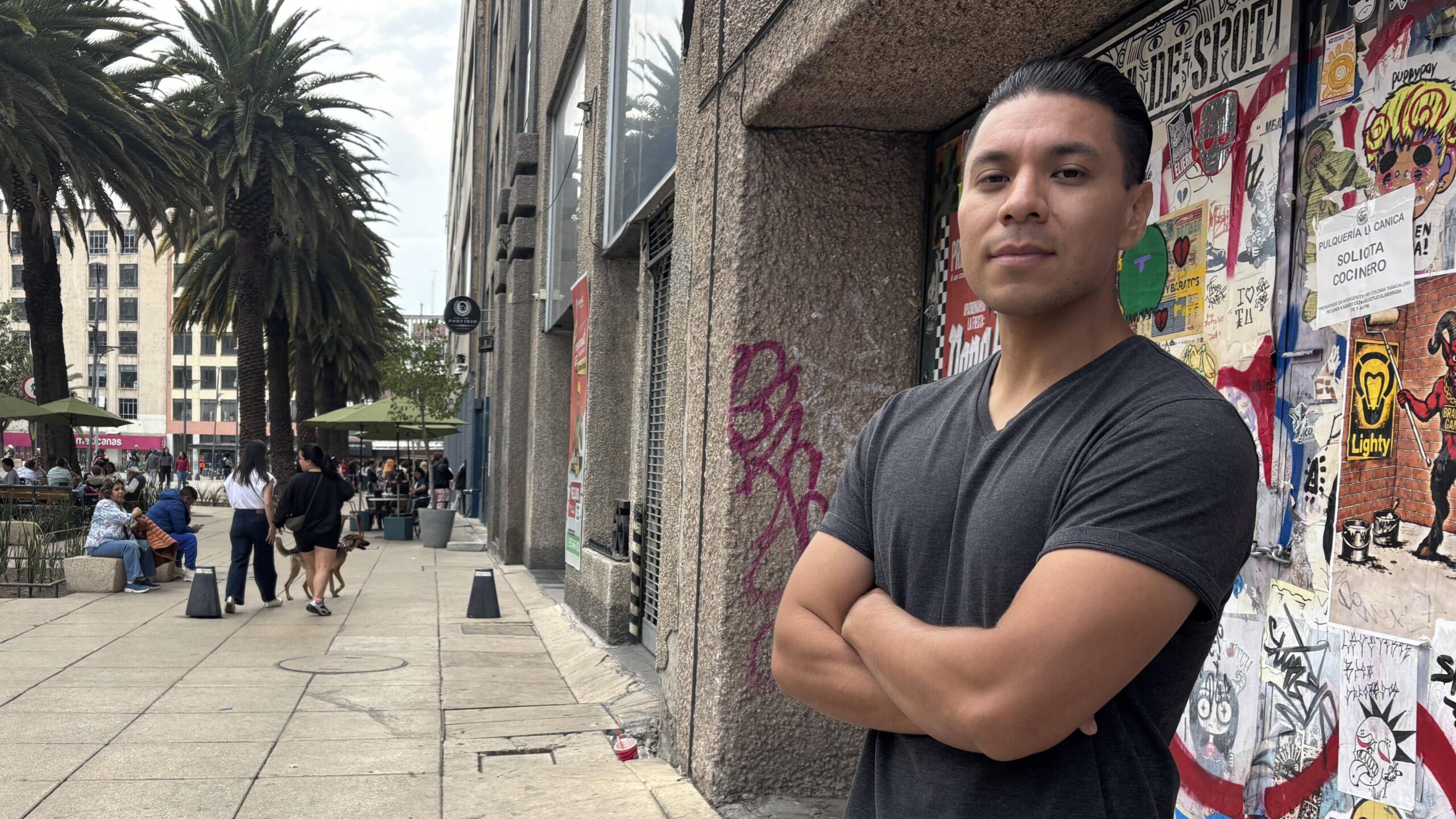
“I was born in Mexico, but I have grown up most of my life in the United States. Being deported back, I feel like I am neither from here nor from there.”
Iván Porras, a 33-year-old Mexican photographer and musician, lived two-thirds of his life in Nevada and California. He arrived there as a child and remained there until his expulsion last year.
That feeling of not fully belonging to either country is shared by tens of thousands of undocumented people who are returning, of their own free will or, for the most part, by force after being detained within the framework of the aggressive immigration policy of the right-wing government of Donald Trump, to a Mexico that they barely remember.
However, many of them have found a small refuge in the heart of the Mexican capital that, in some way, mixes elements of the cultures of both places and that helps them feel more understood by coming into contact with a large community that went through the same experience.
It is called Minute LA (“little Los Angeles”) and is located in the Tabacalera neighborhood of Mexico City, a neighborhood that reminds some of the Californian city due to the numerous presence of palm trees.
In recent years, a large number of Mexicans deported from that US state have been arriving in this area, attracted by the existence of several name centerswhere their ability to speak English and Spanish makes them good candidates for finding work as telephone operators.
Today, it is common to find many of them meeting at Minute LA after their work day, talking spanglish and comfortably jumping from one language to another in bars where they advertise in English snacks & beers and that combine typical food from both countries in their menus.
“In this neighborhood of Minute LA I have met many deportees who have been here in Mexico for a while. We share the same experience, the same struggles (struggles) and we can communicate in English. That helps a lot, because you no longer feel alone or isolated from the rest of the country,” highlights Porras.
The epicenter of this small Mexican Los Angeles is the emblematic Monument to the Revolution, a work that at the time began to be built with the concept of becoming the Legislative Palace of the country.
“For us, (the monument) is important because it was intended to be something completely different. It is essential to remember that sometimes we begin our stories in other places, like many of our repatriated brothers, but that does not mean that it is the end, but rather that it is the beginning of something new,” Shunaxy Estrada, director of volunteers in Mexico at Fresh Comienzos, tells BBC Mundo.
This organization, which helps migrants returning to Mexico with correct, psychological and job search support, among others, has been decisive in the rise of Minute LA
“By having a place to bond and feel identified, it is our way of holding their hand and telling them that they are not alone,” he says.
He cooked for Trump and his government ended up deporting him
In the same Minute LA is the Casa de los Amigos hostel. Its director, Miguel Ángel Lomelí, remembers all the preparations they made last year in anticipation that Trump would fulfill his promise to carry out mass deportations and they would have to welcome more compatriots into the center.
However, “we have not had many Mexican people deported, rather it has been people who could no longer go (to the US) to fulfill the American dream, especially from Central American countries,” he tells BBC Mundo.
The majority of deportees, which last year alone exceeded 160,000, according to Mexican government figures, travel to their home states after returning to their country. Some, however, did not make it: at least 15 Mexicans have died in the custody of the US Immigration and Customs Enforcement Service (ICE) and in anti-immigration operations since the Republican returned to the White House last year.
Erick Flores, a 56-year-old Mexican who spent the last two decades working as a chef in New York City, remembers the harsh conditions to which immigration authorities subjected him in the United States after detaining him while walking down the street at the end of last year.
“They had us in ICE facilities, on a mat, with light for 24 hours and at about 5ºC. In one of the centers, they brought us food and threw it at us telling us in English: ‘Eat, dogs,'” he tells BBC Mundo while walking through Minute LA.
He went through four centers in Texas until, 26 days after being detained, he arrived in Mexico City. “When I first arrived, I was traumatized. I lost almost 6 kilos.”
Flores returned from the US with a striking anecdote. In 2015, before Trump won his first presidency, he had the opportunity to cook for the Republican while working at a corporate office food stand.
“I made a salad for Donald Trump. Something very curious is that, ten years later, he deported me,” he says while emphasizing that he “admired” him in his role as a businessman before he entered politics. “The change that was in him, only he knows.”
Recently, Flores was able to reunite in Mexico with his wife and the 3 children he had left behind when they were still children. 20 years after seeing them for the last time, he met some adults who, he says, understood that his long absence was a sacrifice he made in order to give them a good life.
“When I signed my deportation, I made a steadiness. The US gave me a lot, but I also gave a lot to the US after 20 years paying taxes and contributing to its economy. We are even. And I am lucky because I returned alive: there are many who don’t even count it,” he reflects.
Discrimination, language barrier and stigmatization as challenges
Something very similar thinks Issac Hernández, a 29-year-old Mexican who arrived in California when he was just 7 and who was deported, in his case, during Trump’s first term.
The deportation process “takes away your humanity,” he states emphatically. However, his expedited expulsion was resolved in just over a day, so he acknowledges that he almost feels lucky to have gone through the process then, and not during the right government.
“If I talk about how ugly I felt alone in one day… now I see the news and I feel sorry for those who are going through it, because it is worse. The violence of this group, of grabbing people left and right, without asking or seeing if they have a criminal record… I can’t complain about what I went through, seeing those images that no one should go through,” he insists.
Hernández tells his story after finishing his work day in a name center from Minute LA He proudly says that this job has allowed him to own his own home in Mexico, which in the US “would have been difficult.” However, restarting his life in Mexico and “starting from scratch” was also.
“I couldn’t communicate because at first Spanish was difficult for me. They heard me speak English, and they said ‘it’s a little bit [como se llama a los mexicanos que adoptan costumbres de estadounidenses]’He is a deportee.’ They assume it because of your speech, because of tattoos, because of the way you dress… and that doesn’t help you feel in your own country,” he laments.
And if cultural uprooting were not enough, the language barrier and stigmatization are other great challenges that many of the people who are deported to Mexico face.
Danny Iniestra faced the same discrimination when he returned last October to a country from which he left when he was only 6 years old and of which he had no memory, but which he already proudly wore in tattoos on his body that represent the Angel of Independence or the slogan Made in Mexico.
“The word ‘hate’ is very strong, but… it hurt me a lot because I was not Mexican to the Mexican: I was pocho, gringo, güero, whatever. They even charged me more than what things cost. So, if Mexico is the friendliest country for foreigners and tourists, why aren’t we helping our own people?” he asks.
After almost 20 years in the US, Iniestra recounted his challenges and how he is slowly integrating into his new life in Mexico after years of depression during an interview for “Migrantes and Deportados Talk Spanglish,” a podcast created to give a voice to returnees like him that also has the support of Fresh Comienzos.
“For all this, at Fresh Comienzos we reinforce psychological support, because it is something extremely important. Imagine when you end a relationship with your partner, that this grieving process is not easy. Now multiply it by ‘I am ending a whole life’ in the US and I have to return,” compares Estrada, a member of the organization who highlights the increase in compatriots who support after the rise of the phenomenon of ‘self-deportation’ that had never been seen before.
Deported Mexicans have different plans for the future. Iván Porras hopes to obtain an immigration waiver to return to the United States in a few years and reunite with his partner and 8-year-old daughter, who also have American citizenship and whom he can see from time to time thanks to the fact that they cross the border with Mexico from El Paso, Texas.
“There I had a family, I fulfilled many dreams. I have the same goals I had here in Mexico and I am going to work as hard as I can to fulfill them. But being deported is not going to ruin them for me,” he promises.
Issac Hernández, on the other hand, envisions his future in Mexico after having found a safe place in Minute LA
“For me, Minute LA became like a home. It welcomed me, helped me get a permanent job, the community motivated me to fight for my dreams… and the American dream can also be achieved here in Mexico. Because now I believe it: that the Mexican dream does exist,” he concludes.
Keep reading:
* Interest in moving to the US falls to a historic low, but remains a fundamental immigration destination, survey reveals
* Which immigrants are affected by ICE deportations to third countries? (podcast)
* My life in Mexico: The experience of migrant families after deportation
click here to witness more stories from BBC News Mundo.
Subscribe here to our new newsletter to receive a selection of our best content of the week every Friday.
You can also follow us on YouTube, instagram, TikTok,X, Facebook and in our new whatsapp channel.
And remember that you can receive notifications in our app. Download the latest version and activate them.
- Why Emiliano Zapata was so transcendental in the history of Mexico (and the most beloved revolutionary)
- “Returnees are an easy target”: Mexicans deported from the US who are reunited with the drug traffickers’ watch over