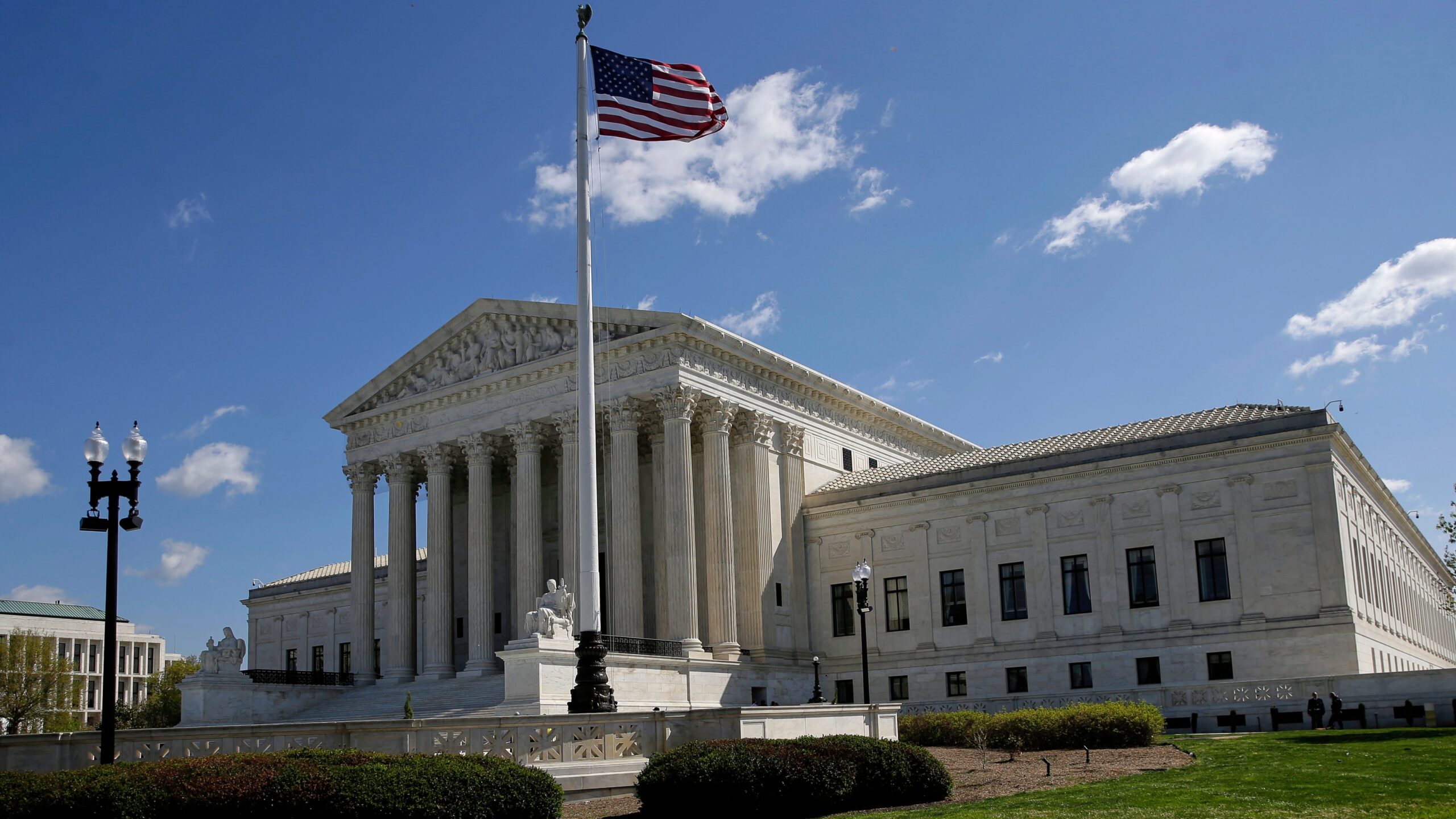
The U.S. Supreme Court is considering whether sweeping court orders to obtain smartphone location data infringe on Americans’ privacy rights and violate the Constitution.
The justices heard opening arguments Monday in the Chatrie v. United States case, which dealt with law enforcement’s reliance on so-called “geolocation warrants” in difficult cases.
The lawsuit was originally filed by Okello Chatrie, whose phone location data helped Richmond, Virginia, police locate him after robbing a bank. at gunpoint and absconding with $195,000 in 2019. Chatrie pleaded guilty to armed robbery and was sentenced to 12 years behind bars, but his lawyers argued that none of the evidence against him should have been admitted at trial.
A Department of Justice (DOJ) attorney argued that virtually any action taken in public while possessing a smartphone does not raise any expectation of privacy.
“An individual does not have a reasonable expectation of privacy with respect to movements that anyone could see, and that he has chosen to allow a third party to analyze for his own purposes,” the long-established US attorney, a top lawyer for President Donald Trump’s administration, said in legal papers.
Law enforcement agencies are increasingly requiring technology companies to hand over confidential phone location data of people who are at a location where a crime is suspected.or in its vicinity, that is, of any person who is within the radius of a virtual “fence”. Geolocation orders, instead of specifying their objectives, force technology companies to hand over to the police or the FBI data on all electronic devices that are in a given location at a given time.
Likewise, privacy advocates and some legal specialists consider geolocation searches to constitute a raid that implicates innocent people, The Guardian reported.
“Does having a cell phone mean you should be subject to a police investigation for crimes that could have occurred nearby?” questioned Paul Ohm, a law professor at Georgetown University, who filed an amicus curiae brief in the case.
Court orders can lead to location data from a person’s phone being shared with police simply because “they were in the wrong place at the wrong time, or worse, because they weren’t, but their phone believed them.” Ohm added.
Law enforcement officers and prosecutors ensure that these geolocated search warrants help them solve crimes when no other solution is available. Judge Brett Kavanaugh expressed concern about “the practical consequences of failing to solve murders.”
Chatrie had activated an optional Google feature called “location history,” which records your location within minutes. The Republican administration noted in its legal documents that “only about a third of active Google account holders opted in to the location history service,” Chatrie’s lawyers indicated in theirs that this represented more than 500 million Google users.
After interviewing witnesses at the bank Chatrie robbed and reviewing security cameras, officers were unable to obtain any leads.. Through a geolocation request, Authorities asked Google to provide mobile phone location data for the 30 minutes before and after the robbery, from all phones located within 150 meters of the bank. This included Chatrie’s phone location data, as well as information about 19 other accounts. The detective in charge of the case asked Google for more information about all of these people, but the technology company refused and, in the end, only requested information about 9 of them. Towards the end of the investigations, that number was reduced to three devices; one of them was from Chatrie and the information included an email address with his name.
The Republican administration has alleged in legal documents that Chatrie chose to allow Google to collect and use his phone’s location dataand that investigators identified him through a court order, although the plaintiff’s lawyers have argued that the aforementioned order was too broad.
Keep reading:
• This is how phones are tracked in Texas without a court order (podcast)
• What to check before selling or giving away your cell phone
• Finally, some good news about robocalls