When you step onto the runway of any major airport in the world, you notice an unmistakable smell. A slightly sweet and oily aroma, reminiscent of old workshops or paraffin lamps of yesteryear. It’s as much a part of the travel experience as lukewarm coffee and queues at immigration for passport checks. It is, of course, the omnipresent smell of aviation fuel.
That penetrating aroma has become much more expensive in recent weeks. The price of aviation fuel has risen drastically in international markets since the start of the conflict in the Middle East. There are now concerns that, unless the Strait of Hormuz is reopened soon, there could be shortages in some regions in the coming months.
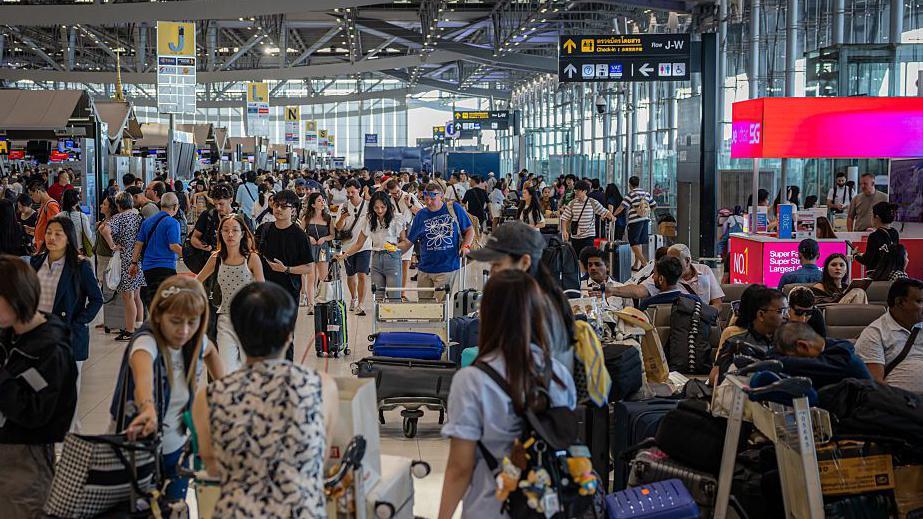
Many airlines have already raised ticket prices and some have cut capacity. Unless additional supplies can be found, the lack of fuel could lead to further disruption and cancellations ahead of the peak summer holiday period.
The crisis has highlighted how vulnerable the sector is in places like the United Kingdom, Europe’s largest consumer of aviation fuel, to disruptions in the Middle East. What impact could this have on our summer holidays and what could be done about it?
The race to achieve flammable
The Gulf region produces much more fuel for aircraft than it needs for its own purposes. As a result, under normal circumstances it is an important exporter, representing around 20% of the fuel sold each day in international markets.
Europe as a whole is a key buyer of this fuel. Due to a lack of refining capacity, the continent relies heavily on imports, of which more than half typically come from the Gulf.
However, with the Strait of Hormuz blocked for eight weeks, those supplies have not been available, prompting a race to source fuel elsewhere. This has caused a spectacular increase in prices.
At the end of February, before the first US and Israeli airstrikes, aircraft fuel was trading at $831 per ton in Europe.
By early April, it had reached $1,838, an increase of more than 120%. It has since dropped, but has remained consistently above $1,500.
Lack of refining capacity
Aircraft fuel is essentially a highly refined form of kerosene with specialized additives, and is typically produced from the fractional distillation of crude oil.
With supply largely dependent on the availability of refining capacity, the loss of production in the Gulf has caused jet fuel prices to rise much more than crude oil prices.
“In the last 2 years or so, 5 refineries have been closed in Europe, while the demand for aircraft fuel has been increasing year after year,” explains Amaar Khan, head of aircraft fuel pricing at Argus Media.
“Therefore, we see a tighter supply and higher demand,” he adds.
The United Kingdom is especially dependent on imports, which represent 65% of its needs. Two of the refineries that closed in Europe were British, leaving only four operating in the country.
Fewer and more expensive routes
For airlines, fuel is a significant expense. It typically represents between 25% and 30% of your operating costs, according to the International Air Transport Association (IATA). Consequently, if the price rises, it can have a significant impact on your profitability.
In Europe and Asia, it is common for airlines to use hedging strategies to limit their exposure to rising prices, purchasing fuel or other petroleum products in advance at a fixed or capped cost.
However, this does not offer complete protection. EasyJet, for example, covered 80% of its fuel supply for the first half of the year at $717 per ton, but acquiring the rest at current prices cost the airline an additional $33 million in March alone.
Other companies, especially American ones, have preferred not to hedge at all in recent years, as it can be expensive when prices drop. This has left them very exposed to the crisis staunch.
Some airlines, such as Air France KLM, Air Canada and the Scandinavian SAS, have already reacted by cutting their summer schedules. The German group Lufthansa announced earlier this month that it would cut 20,000 flights between now and the end of October.
“If a route was marginally profitable before this crisis hit, it is now clearly in the red and losing huge amounts of money,” says Jonathan Hinkles, former CEO of regional airline Loganair and current CEO of Skybus.
Rates have also been rising. This has been more important on long-haul routes, especially those typically operated by the main Gulf airlines, where a sharp reduction in refining capacity has combined with high fuel prices to make tickets considerably more expensive.
A flight from London to Melbourne (Australia) in June now costs 76% more than last year, for example, according to a study by the consulting firm Teneo.
The American airline United Airways has been especially firm in guaranteeing that passengers will bear the brunt of the increase in fuel. Its CEO, Scott Kirby, told investors last month that the company would do “whatever it takes to recover 100% of the increase in aviation fuel prices as soon as possible.”
IAG, owner of British Airways, the Spanish Iberia, Vueling and Level, and the Irish Aer Lingus, has also warned that travelers will have to pay more, while the British Virgin Atlantic has introduced surcharges ranging from $68 for a return ticket in economy class to $488 for an industry class fare.
However, on short-haul flights within Europe, the impact on fares has so far been much more moderate. In fact, according to the CEO of Hungarian low-cost airline Wizz Air, József Váradi, prices have been falling as airlines have tried to convince potentially reluctant customers to travel.
“People just don’t know what’s going to happen… so there’s a degree of indecision,” he told reporters in late April.
“But, to be honest, that level of indecision can be overcome through price incentives. Therefore, in the short term, what we are seeing is that prices are going down,” he said.
According to John Strickland of JLS Consulting, the rise in prices gives well-covered low-cost airlines an advantage over their rivals that have not purchased as much fuel in advance.
“They will try to put pressure on other companies that are not in such a strong position,” he says.
Will there be a lack of fuel to fly?
Although fuel prices have clearly been the biggest concern for airlines since the start of the conflict in Iran, there is another looming concern that particularly affects Europe: the risk of supplies running out.
In mid-April, the head of the International Energy Agency (IEA), which advises 32 member governments on energy supply and security, warned that Europe had “perhaps six weeks of fuel left for airplanes.”
A detailed analysis by the IEA noted that, although imports from the United States had recovered, the additional fuel arriving across the Atlantic was likely to only replace just over half of the lost supplies from the Middle East.
If this trend continued, he warned, reserves would reach critical levels in June. This would mean that “shortages could occur at certain airports, leading to flight cancellations and a drop in demand.”
It is important to note that although Europe relies heavily on Middle Eastern sources, it also obtains fuel from elsewhere. The shipments come from East Asia, particularly South Korea and Taiwan, as well as the US and Nigeria.
However, East Asian refiners rely heavily on crude supplies from the Middle East, which have been constrained by the war, reducing the amount of aviation fuel available for export.
For their part, imports from the US, although growing, have been limited by the fact that the US aviation market uses a different type of fuel than most of the rest of the world.
In the USA, Jet A is used, which has a higher freezing point than the Jet A1 supplied in Europe. Not all US refineries that produce jet fuel are currently capable of producing Jet A1, limiting the surplus that can be shipped across the Atlantic.
Until last year, India was also a major source of fuel. However, the European Union’s (EU) ban on imports of refined products made from Russian crude oil had a major impact on supply.
“In practice, what this led to was a massive withdrawal of Indian aircraft fuel from the European market. It simply became too complicated,” explains Amaar Khan of Argus Media.
As a consequence, reserves have been reduced. Stocks in the important logistics center of Amsterdam-Rotterdam-Antwerp (Netherlands) are at their lowest level in the last six years, according to purchasing intelligence company Beroe.
Fall in reserves
Before the conflict, Europe as a whole had reserves for about 37 days. Now, this figure has likely dropped to 30 days, according to the company. 23 days is the critical point at which the IEA believes that some airports would run out of fuel.
Beroe’s analysis suggests there is a “high risk of shortages if the closure of Hormuz continues.”
Khan agrees. “I think there is a huge risk,” he says, although he notes that the effects of any shortages would not be felt equally. “Large demand centers and large airports will probably be prioritized over smaller demand centers,” he explains.
Wizz Air CEO József Váradi is optimistic that additional supplies will be found, as there is “a lot of room for creativity” when prices are so high.
“I don’t think we’re going to run out of fuel,” he told reporters in April. But he acknowledged that the shortage would not be felt equally throughout Europe.
“It’s not going to be as if each and every European airport were going to be affected at the same minute of the same hour. That would be chaos,” he explained.
“There is multiple suppliers, and each one may be in a different situation, so you may not get aviation fuel with one, but you may with another,” he added.
“But the definitive measure, obviously, is that if there really is no fuel anywhere, then (the flights) will have to be cancelled,” he admitted.
What can be done?
Publicly, most airlines are optimistic about the fuel supply situation. But behind the scenes, in both London and Brussels, they are being asked to adopt measures to mitigate the impact of both high prices and potential shortages.
In the United Kingdom, the government is preparing a series of concessions. These include allowing airlines to cancel flights at busy airports, such as Heathrow, with sufficient notice, without the risk of losing valuable take-off and landing slots.
Under normal circumstances, if airlines do not use slots 80% of the time in a given season, they lose the right to use them the following year. In practice, this may encourage airlines to fly half-empty planes to preserve their slots, which can be worth tens of millions of dollars.
The new plan would make it easier for them to cut their flights in advance, rather than being forced to cancel them at the last minute. For example, it would make it easier for an airline that has several flights to the same destination on the same day to eliminate one or two services without being penalized.
Refineries have also been asked to maximize supplies of fuel for aircraft, while the government is studying the possibility of allowing Jet A1 imports from the US, although that will depend on whether such a measure would be viable with existing infrastructure.
Authorities have made clear that cancellations and serious delays due to fuel shortages will be considered “exceptional circumstances.” Under EU regulations, this will allow airlines to avoid paying compensation to passengers, although they will still have the right to a refund or an alternative flight.
Rules that typically restrict a practice known as “tankering” are also likely to be relaxed.
This practice consists of planes taking off with much more fuel than they need for a flight from airports where it is cheap, in order to limit the amount of refueling needed at their destination, where it may be more expensive. This can mean savings for airlines, but it also implies additional fuel consumption, since the plane is heavier when taking off.
All of this, however, is designed to address the symptoms of the shortage, not the causes.
And in the region?
The region saw 39.4 million people travel by plane in February, 6% more than in the same month of the previous year, according to data from the Latin American and Caribbean Air Transport Association (ALTA). However, the conflict in the Middle East threatens to stop this good streak of Latin American commercial civil aviation.
That same organization warned, in a report published last April, that the region has become a net importer of aircraft fuel in the last decade. The reason? Local refineries, particularly those in Mexico and Venezuela, have not been modernized or expanded.
“We are paying double what we paid a month ago for aviation fuel. This increase in cost has to be passed on to prices,” recently stated Roberto Alvo, CEO of the airline Latam, making it clear that passengers will have to pay more for their business or pleasure trips.
And if the above were not enough, the director of the Chilean-Brazilian company also announced that they were studying the closure of some of their current routes, reported the Peruvian newspaper El Comercio.
But Latam is not the only Latin American airline that has taken measures to adapt to the turbulence of the energy market.
“Yes, we are going to have to increase tickets,” declared Gabriel Oliva, president of the Colombian Avianca, at the beginning of April.
A similar announcement was made by Aeroméxico, where they reported that they would adjust upwards to cover the 13% increase in the price of fuel. However, Andrés Conesa, director of the company, assured that the increase would focus mainly on international flights, which represent 70% of the firm’s income, reported the newspaper Proceso.
However, these measures may not be enough. “With expected net margins of 4% in 2025, airlines cannot absorb increases of this level (in fuel),” warned Peter Cerdá, IATA regional vice president for the Americas, at an event in Chile last month.
And although the recent bankruptcy of the American Spirit Airways, which covered twenty routes between the US and Latin America, could be interpreted as a bad sign, Latin American airlines are seeing it as an opportunity. Thus, Avianca announced this weekend that it will take over some of the routes of the defunct competitor.
*This article was edited. click here for ogle the customary version in english.
Keep reading:
* These are the 10 states where it is cheapest to buy gasoline
* Drivers in the US have spent $8 billion more on gasoline since the start of the war with Iran
* Israel’s attack on Iran’s largest pure South Pars gas field affects world markets
click here to see more stories from BBC News World.
Subscribe here to our new e-newsletter to receive a selection of our best content of the week every Friday.
You can also follow us on YouTube, instagram, TikTok,X, Facebook and in our whatsapp channel.
And remember that you can receive notifications in our app. Download the latest version and activate them.
- “Europe has aviation fuel left for about 6 weeks”: how the war in Iran is putting the supply of gasoline for planes at risk
- Lufthansa cancels 20,000 flights scheduled for the coming months due to rising fuel prices
- How record oil prices set off a chain reaction that affects our daily lives