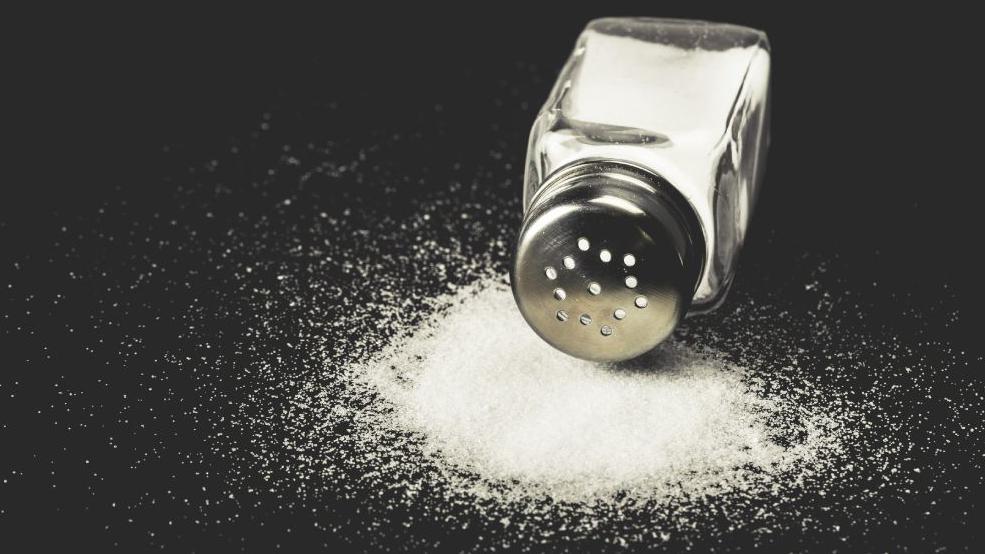
Why do we like salt so much? And how does it make food taste so good?
It is in almost every cuisine in the world, either in the form of tiny grains or as part of basic condiments in some regions (soy sauce, for example, can have between 14%–18% salt).
Chemically, it is sodium chloride. It is made up of ions, charged atoms, of sodium and chlorine.
What happens when one of those small crystals touches our tongue?
“Taste is a sense that allows us to detect chemical substances in our environment that can be beneficial or dangerous, through the taste buds,” explains taste expert Courtney Wilson, from the University of Colorado School of Medicine in the United States.
“Those taste buds are small clusters of garlic clove-shaped cells that are scattered throughout the tongue. Those cells have receptors that evolved to react to certain types of chemicals,” he adds.
When it comes to salt, we have receptors that react specifically to sodium.
“They are essentially small pores on the surface of the cell that only allow certain ions to pass through. So when sodium ions are present, they can flow through that small channel; that cell is alerted to the presence of sodium and sends that electrical signal down the nerve and all the way to your brain,” Wilson says.
But why does it taste so good to us?
“Not always! We basically have two systems: one that tells us when the flavor is tasty, and another that tells us that it is too much and you should probably spit out,” says the expert.
“If you have the right concentration of salt, the amount that will keep your body at that right point of enough salt, it’s going to taste really delicious.”
That, explains Wilson, is because your body always tries to keep the salt content within a narrow range because, although the presence of salt is necessary for the body to function, too much can be harmful.
“Maintaining the right amount of sodium in our body is super important. The electrical signals that your brain cells send to each other and to your muscles and receive from your sensory systems, even your thoughts, all of that depends on sodium.”
And to achieve this, it uses flavor: quantity can delight or displease us.
But salt does more than “salt”: it can enhance other flavors. Do we know how this mechanism works?
“The simple answer is no,” Wilson confesses.
“The more complicated answer is that there is some evidence that taste cells communicate with each other, which would affect how much they respond to a certain stimulus in the mouth, whether sweet, bitter or salty. So adding salt could affect the taste bud’s response to another quality,” he says.
“But it could also be happening further down that information pathway. It could be happening at the level of the brainstem or in your gustatory cortex, where the information is coming in and cells may be interacting to modulate our perception.”
So the magical and transformative power of salt, the one that makes candy with a little bit of it tastier, remains a mystery. Perhaps it changes the behavior of our taste cells, or perhaps the way we perceive their signals in the brain.
But salt is not just a seasoning. As Wilson says, it is necessary for our body to function properly. Could that be part of the reason we find it so appealing?
Without salt, there is no life
“Animals, including us, use sodium for various purposes. It is essential for life,” says Joel Geerling, associate professor of neurology at the University of Iowa, USA.
“About a third of our daily energy expenditure is dedicated to pumping sodium from the inside of a cell to the outside,” he emphasizes.
“Every cell in your body has a sodium-potassium pump in its outer lining, which runs all day, pumping sodium ions from the inside.”
When that sodium is outside our cells, it tries to rush back in, a bit like water being retained behind a dam.
Our cells control the movement of sodium through special channels. When they open, sodium enters with force and our cells take advantage of the energy of that movement for all types of processes, including the one that Geerling trains.
“Sodium ions burst into the cell and cause a rapid and marked change in membrane voltage, known as a spike or action potential in the neuron, not only in the brain, but also in the muscle cells of the heart, which keep you alive, beat by beat,” says the expert.
If we didn’t have sodium, our cells simply wouldn’t function.
Have we evolved to want it because it is so prevalent that we really need to make sure we have enough?
“It’s a very interesting question,” says Geerling, who has been researching the brain to try to understand why we crave salt.
“Animals that live in the sea have a lot of sodium around them and, in fact, they have the opposite problem to those on land: they need to keep some of the sodium out and maintain an internal balance.”
With land animals, the situation is the opposite.
“Sodium is very scarce on land. If you live far from the sea, and especially if you don’t eat meat, you will have very little sodium in your diet,” he says.
And he explains: “Carnivores eat other animal tissues, which have about 0.9% sodium chloride, so they usually consume enough salt. But herbivores, if they only eat plants, will have a very high potassium content and practically no sodium.”
“Elephants are a famous example. There are herds of elephants in Africa that remember the location of caves with salt on the walls, where they procure it with their tusks,” he continues.
“Deer look for salt licks, and hunters, to attract them, use salt blocks similar to those kept by those who raise horses, so they are healthy, and so on.”
“Animals whose diet is purely vegetarian need to have a source of salt, and tend to show a stronger appetite for salt even in the wild,” completes Geerling.
Humans are omnivores, so we have to make sure we get enough salt in our diet and maybe that’s why we crave it so much.
like elephants
Today, most people get enough in their diet, but for our ancestors, finding it would have been necessary. And, just like elephants, ancient humans would have been drawn to natural sources of this precious mineral.
Places like the world’s oldest operating salt mine, located on a mountain in Hallstatt, Austria.
There is evidence that people started digging for salt there in 5000 BC and surprisingly, salt is still mined commercially today.
“250 million years ago, this place was the shallow part of a large sea, which then became disconnected. The water began to evaporate, and for thousands of years, large layers of rock salt accumulated. When the Alps formed the limestone rock moved above these layers of salt,” says Daniel Bradner, archaeologist at the Natural History Museum in Vienna.
The Hallstatt mine was 200 kilometers from the sea, so its vast natural salt deposits have been an incredibly valuable resource for people for thousands of years.
“Mining began here 7,000 years ago, in the Neolithic. Early farmers and settlers discovered the salt deposit from natural brine springs on the surface, and then they started digging,” explains Bradner.
“In the Bronze Age, about 3,500 years ago, there was already fully evolved deep mining, extending more than 250 meters below the surface, with organizational structures, special inventions for its tools and a transportation system.”
“They were dedicated to large-scale rock salt mining and were the predominant supplier to much of Central Europe,” he adds. “Salt is a necessity to survive in a place long term, so it was necessary to be able to settle in the Alps.”
Salt neurons
Prehistoric people living in the Alps and beyond used salt to preserve their food and keep their animals alive during the winter.
If you didn’t have enough, the consequences were dire.
“The organs, all the cells, swell,” says neurologist Geerling.
“This is a serious problem mainly in the brain, because if it swells too much, it begins to come out through the hole in the wrong part of the skull called foramen magnumwhich is very dangerous. So you can’t let the sodium concentration get too low.”
Part of Geerling’s research into how we regulate salt concentration has to do with controlling the body’s water content, and it’s the antidiuretic hormone that’s responsible.
“It tells the kidneys how much water to retain, and that is very strictly regulated minute by minute, throughout the day.”
But that’s not the only way our body can control salt levels. In fact, in his work, Geerling has discovered mechanisms within the brain that drive mineral-seeking behavior.
“In my laboratory, we study a tell group of neurons – the HSD2 – that detect the levels of a hormone called aldosterone. It is invented in the adrenal glands when the volume of salt and water in the body is not sufficient and the heart begins to have difficulty maintaining blood pressure,” he explains.
“In these cases, aldosterone increases, and that triggers the neurons that drive the animal to seek and consume more salt,” he adds.
“So far we have identified them in mice, rats, pigs and humans. We have not done a deliberate and careful study of other species, but they seem to be in mammals in general.”
So we have neurons in our brains that are not only dedicated to monitoring how much salt we have, but also to prompting us to seek it out.
“Yes, it’s fascinating. It’s a very specific behavior. We haven’t found anything else that these neurons do. We’re still investigating, but it seems that what they specifically cause is that the animals consume more salt.”
So why do we like salt so much?
On the one hand, because it changes the taste of things, although we don’t know exactly how.
On the other hand, because it is necessary for our cells, so we have evolved to crave it and find it tasty in the right quantities.
In fact, we even have tuned neurons in the brain that drive us to seek it out, an incredible system, designed with great precision to generate our appetite for salt.
* This article is an adaptation of the episode “Why does salt taste so beautiful?” from the BBC series CrowdScience, available wherever you listen to your podcasts.
CrowdScience answers questions submitted by people around the world, consulting specialists who are at the forefront of knowledge. If you want to contact us, click here.
Keep reading:
* Salt substitutes could prevent millions of deaths, new study says
* How to reduce your salt consumption according to experts
* 6 myths that exist about salt (and how much you should consume per day)
click here to survey more stories from BBC News World.
Subscribe here to our new newsletter to receive a selection of our best content of the week every Friday.
You can also follow us on YouTube, instagram, TikTok,X, Facebook and in our whatsapp channel.
And remember that you can receive notifications in our app. Download the latest version and activate them.
- How much salt is too much and why consuming too little can also be harmful to your health
- Himalayan pink salt, reduced sodium, refined: is there really a type of salt that is better for your health?
- Why is the sea salty if it is fed mostly by freshwater rivers?