By EFE
The president of the United States, Donald Trump, has made his image an omnipresent element in official symbols, identification documents and even buildings, in an accumulation of initiatives that show the obsession with stamping his private seal on multiple areas of institutional life and creating a legacy before even leaving office.
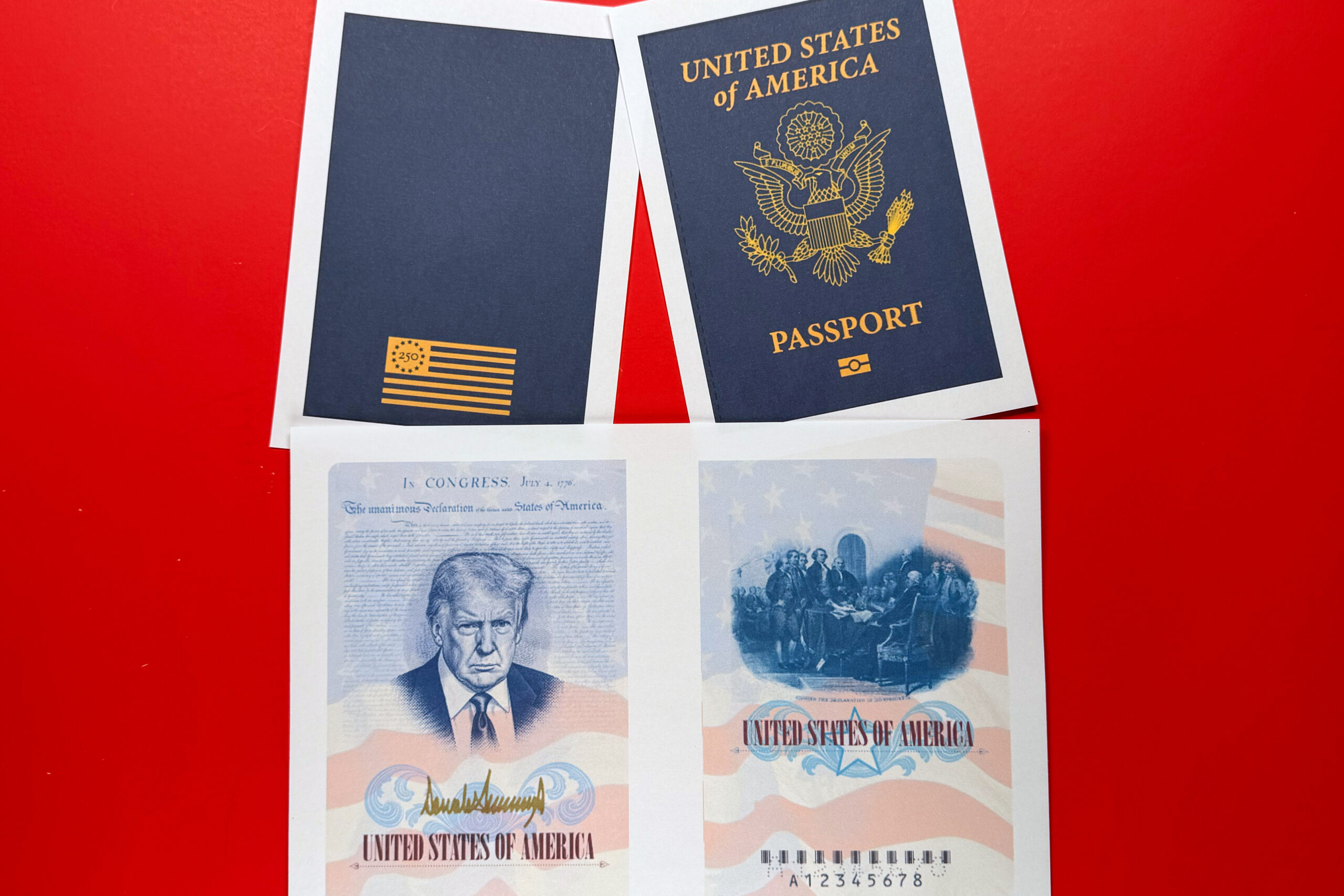
The most recent of these actions is the launch of new commemorative passports for the 250th anniversary of the country’s independence, which will include the face of the president along with the Declaration of Independence and the American flagin addition to his signature in gold on one of the interior pages.
But Trump’s presence is not limited to passports.
On tickets, parks and buildings
The Treasury Department announced that his signature will appear on future dollar bills, which would mark the first time that the signature of a sitting president is included in US paper money, with an issuance scheduled before July 4 and which, according to the Government, seeks to highlight the economic achievements of his mandate.
Added to this is approval of a 24-karat gold commemorative coin with Trump’s image resting his fists on a desk, which is already on display at the National Portrait Gallery in Washington.
The design, endorsed by a federal arts committee made up of members appointed by Trump himself, has been questioned by regulations that prohibit representing sitting presidents in currency.
Outside the monetary sphere, the image of the president has extended to the urban landscape of the capital, where large photographs of him cover building facades in a visible omnipresence unusual for a sitting president.
His face has also made its way into the field of hiking, since it stars in the annual passes of the national parks as part of the celebrations for independence day, so that access to mountains and forests is now accompanied by the same official portrait.
Your name in emblematic institutions
The strategy of placing his last name in stone has reached some of the most symbolic buildings in the American capital, where spaces conceived as monuments “for everyone” have come to bear, to a greater or lesser extent, the Trump brand.
Last December, the State Department unveiled the new façade of the United States Institute of Peace, with the label “Donald J. Trump United States Peace Institute”, renaming for the first time a center created by Congress and dedicated for decades to the study and prevention of conflicts.
A few weeks later, the historic Kennedy Center in Washington, the capital’s largest performing arts venue and official memorial to John F. Kennedy, “It was renamed by its board of directors as the Donald J. Trump and John F. Kennedy Center.”a decision that unleashed the discomfort of the Kennedy family and opened the debate on the extent to which the president can transform a cultural legacy dedicated to the legacy of the assassinated president.
Furthermore, in a frustrated attempt, Trump even proposed renaming Washington-Dulles Airport and New York’s Penn Station with his name as a condition to unlock federal funds for a railway project in the Big Apple, valued at about 16 billion dollars.
Keep reading:
• Trump plans to build a 76-meter triumphal arch in Washington: this is the design
• Golden Trump statue and skyscraper: This is what the president’s library in Miami would look like
• Palm Seashore International Airport could change its name to President Donald J. Trump