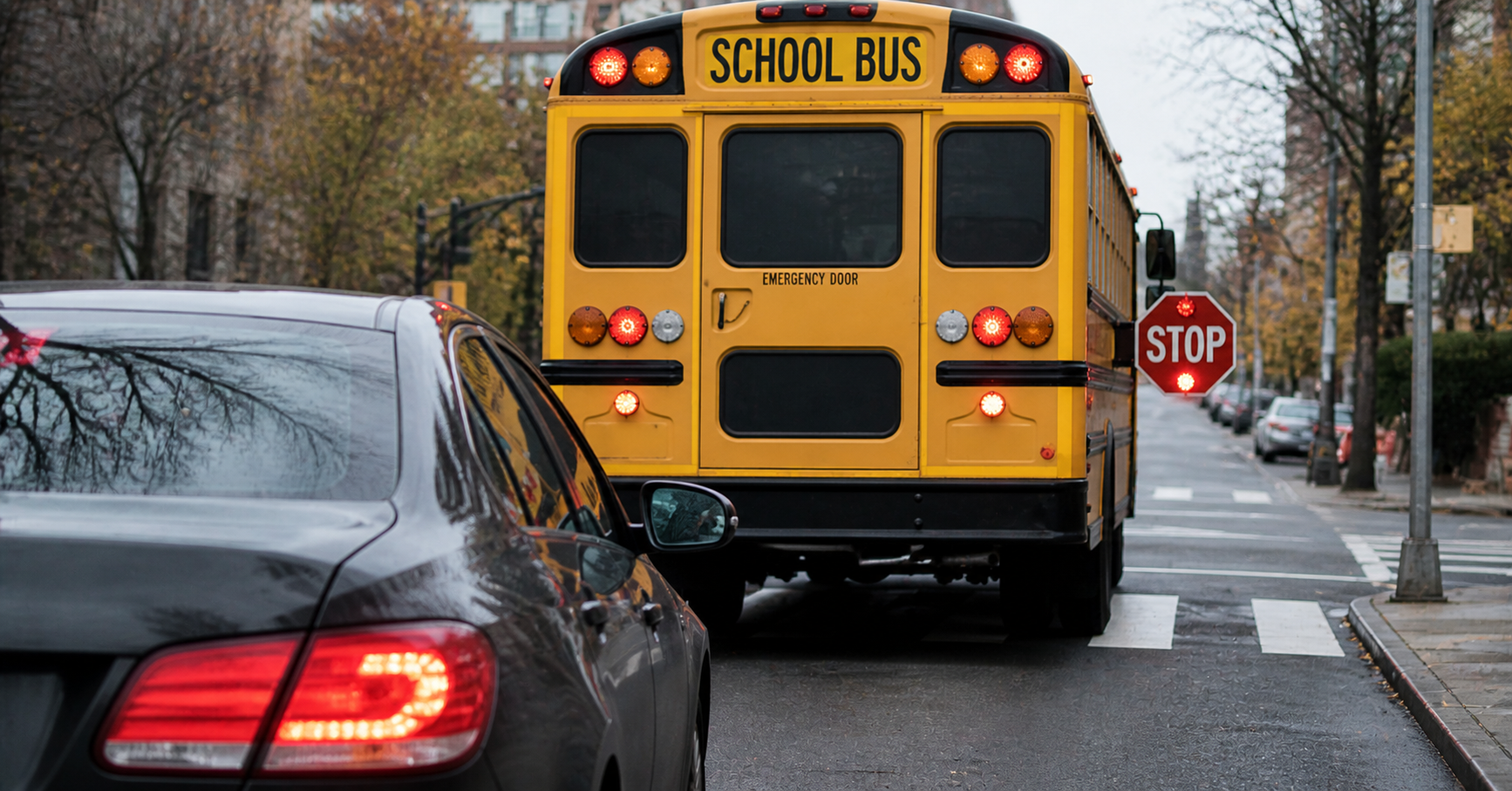
In New York, overtaking or passing a stopped school bus can cost hundreds of dollars, points on your license, and even a suspension of your driver’s license. The rule is strict and, even so, it continues to cause confusion among drivers.
The issue of traffic incidents is escalating on the public agenda, after numerous episodes involving school vehicles and minors. Although the cases have diverse dynamics and responsibilities, road safety experts once again emphasize the rules, duties and sanctions to guarantee a healthy coexistence on public roads.
What the law requires when a school bus stops
The state’s traffic law — contained in Automobile and Traffic Regulation §1174 — states that all vehicles must come to a complete stop when a school bus is stopped with red lights flashing and the “STOP” arm extended. This obligation applies in both directions of the road, even if the driver is traveling in the opposite direction.
The only relevant exception is when there is a wide physical median that completely separates both directions, which prevents the pedestrian crossing between lanes. In all other cases, moving forward is a violation.
The objective is to protect children who get on or off the bus and who often cross the street unpredictably.
How much does the violation cost?
The sanctions are staggered and increase with recidivism:
- First offense: between $250 and $400
- Second offense (within 3 years): between $600 and $750
- Third or more: between $750 and $1,000
Administrative surcharges and, in some cases, judicial costs are added to these amounts. According to the New York Department of Motor Vehicles (DMV), this is one of the most severe offenses among common traffic violations.
License points and risk of suspension
In addition to the fine, the violation adds 5 points to the driver’s license. The point system in New York contemplates the suspension of the permit when reaching 11 points in 18 months, which means that repeating this behavior can have more serious consequences than the financial penalty.
It is also common for insurers to increase the cost of insurance after these types of violations.
Cameras on buses: fines without police contact
In recent years, New York school districts have incorporated cameras on the buses themselves to detect vehicles that do not stop. This system allows sanctions to be issued without the need for an officer to be present.
In these cases, the fine is usually civil (against the owner of the vehicle) and does not always imply points on the license, but it does represent a cost that can exceed $250. The program is supported by state laws that authorize its use to enhance school safety.
The rule that returned to the center of the debate after a recent case
A recent case in New York, in which a child died after being hit by a school bus at the beginning of the school day, once again put the focus on road safety in school environments. Although the circumstances of the incident remain under investigation and not all incidents respond to the same dynamic, authorities agree that the times when students pick up and drop off are the most critical of the day.
Organizations like the National Highway Traffic Safety Administration (NHTSA) point out that the so-called “danger zone” around the bus—the immediate meters where drivers can lose visibility—concentrates a good part of the accidents involving minors.
In that context, the obligation to stop completely is not a formality: it is a measure designed to avoid tragedies.
The most common (and most expensive) mistake
One of the most frequent mistakes is believing that you can move forward if you drive in the opposite direction or if the bus “is already about to start.” Both interpretations are incorrect.
While the red lights are active, the driver must remain stopped. Failure to do so is a clear violation, even if there are no children visible at the time.
Why is it one of the strictest standards?
New York has tightened this regulation over the years because of the risk involved. Children can cross the road unexpectedly and, in many cases, are out of the driver’s field of vision.
For this reason, both the DMV and traffic safety agencies insist on a simple message: always stopping for a school bus is not only complying with the law, it is a basic prevention measure.
Continue reading:
How to pass the DMV road test on the first try?
12 keys to understanding the new New York DMV point system in 2026
New York will require transparent bars in businesses: fines and costs worry merchants