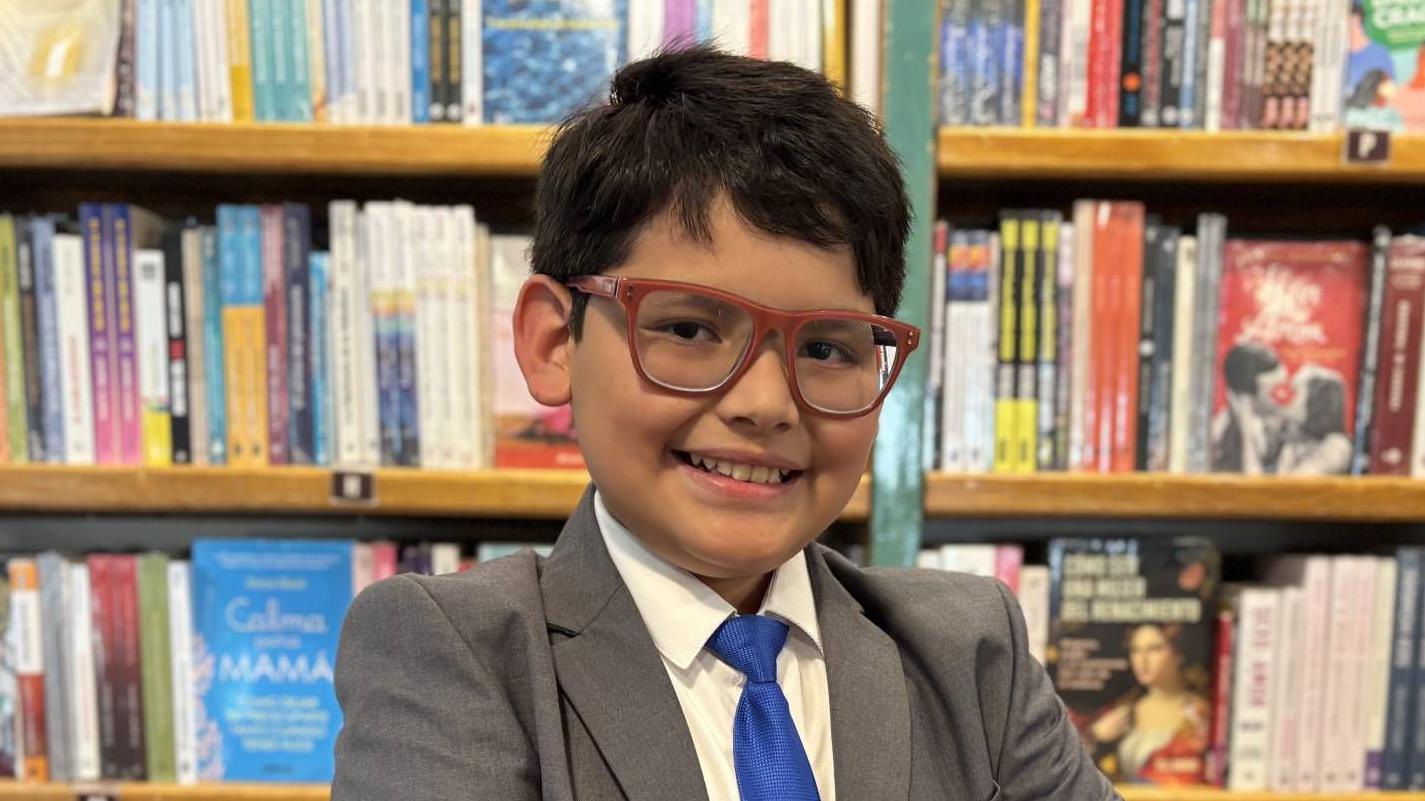
David Camacho probably doesn’t like the title that heads this article.
First, because he does not identify with the description of a “genius child,” despite the fact that his IQ of 162 is well above the 130 that the World Health Organization (WHO) sets as the minimum to consider a person with high abilities or intellectual giftedness.
“The geniuses are already in the grave and, if they are geniuses, it is because they did great things,” he modestly tells BBC Mundo.
Second, because he recognizes that he does not really like being compared to other brilliant minds such as physicists Stephen Hawking or Albert Einstein, who have an estimated coefficient of 160.
“I’m 10 years old and I’m just starting out. Maybe I’ll be a genius when I’m 70, but when I’ve already done great things in life, right?” he insists with a big smile.
However, there is a genius with whom he feels so inspired that he has even adopted his last name for social networks: ‘David da Vinci’.
“My kindergarten teacher told me a lot about Leonardo da Vinci and how he was a polymath: someone who combines science, technology, engineering, mathematics, arts, humanities… a little bit of everything,” he remembers.
“I was impressed with his story and then I said: ‘I want to be like him’, to do great things.”
For now, David doesn’t seem badly on track toward that dream.
From NASA to writing your own book
Always smiling, eloquent and with a speech as organized as it is surprising for his young age, this boy from Querétaro informally tells us that he gives lectures at universities and for international organizations, and that he is about to publish a book.
He also had the “great opportunity” of being selected to go to NASA headquarters in Houston and participate in a space training program, where he was able to pilot an assisted flight and experience zero gravity.
That’s where your future could go, but without closing any doors.
“I would like to do the first surgery in space. Do the next SpaceX, be the next Elon Musk, something like that. Combining it all with business, with the humanities… I have my whole life ahead of me!” he says.
David is currently studying at an international online school that will certify him to enter university. He speaks Spanish, English, French and German, and has just started with Russian, Portuguese and Italian.
He assures that it is “a pride” to have such a high IQ and that what he likes most about being a child with high abilities is being able to understand things quickly and learn more quickly.
“Not many people are born with this, so I would like to use it for the benefit of children and the well-being of humanity, to leave my mark,” he says.
However, he believes that what it is to be a child genius is not always understood.
“Many people think that we should know everything, but we are not fortune tellers, you have to teach us. It does not mean that we have all the answers to the universe.”
And he adds, laughing: “Many times they challenge me, saying: ‘If you’re such a genius child, tell me the square root of I don’t know what, multiply by so much…’ Wait for me, if I haven’t learned it, I won’t know.”
The bullying that he knew how to take advantage of to undertake
His mother, Claudia Flores, remembers the first clues that made them think there was something special about David.
“We were on a long road trip and he knew like 40 children’s songs. We sent him to school and he was happy for 15 days, but then he started telling me: ‘Pass me to the big kids, I want to learn more,'” he tells BBC Mundo.
“I was very bored,” David confirms.
But the decisive moment came with the Covid-19 pandemic. His mother sat next to him while he took the online classes and realized that he learned very quickly compared to the other children.
“I asked him what number was known and we counted up to millions. So I started to investigate what children with high abilities were, and specialists told us how to handle it,” says Claudia.
But, despite all his achievements, getting here has not been easy for David. He claims that he suffered “tremendous” harassment in which the school of his dreams specialized.
“The other children didn’t understand why someone who had just started school could know more things than them or how they could do so many things. Their way of reflecting it was by bullying me,” he explains.
David recently decided to take advantage of that bad experience to turn it around and use it to develop Macayos, an app that will be available later this year.
He elaborates it as “the first digital platform in Mexico created with artificial intelligence, which in a fun way teaches children skills to know how to manage their emotions.”
To all those who bully children like him, David asks for empathy and to be inclusive. “We are not aliens: we have high abilities, but we are still children.”
In fact, although he recognizes that many of his relationships are with adults because he feels “not fitting in” with many children, he assures that he also does things that are normal for his age, like playing with his blocks or going to the park.
“Many think that I am a child disguised as an adult, but I am a child who does childish things… and also part of adult things,” he summarizes.
The diagnosis of gifted children
He was lucky in that his diagnosis of high abilities came relatively quickly into his life.
A large number of children are misidentified as having attention deficit hyperactivity disorder (ADHD) because they are restless or bored at school. It can also be confused with autism.
“What happens is that the child already understood what is being explained and wants something more,” says Claudia.
In fact, according to estimates managed by institutions such as the Talent Attention Center (CEDAT), in Mexico it is estimated that there could be one million gifted children. However, the vast majority have not been identified and 93% of them were misdiagnosed.
“I am sure that in Mexico there are many children like me who are not being supported or guided. It makes me very sad to see that there are great talents and that they have to go to other countries because their family did not have the resources or they did not find the opportunities here,” David reflects.
Throughout the interview, the child speaks very quickly. He jumps from topic to topic with ease and goes back if he feels he forgot to mention something important.
Claudia recognizes that being a mother of a child like this is quite a challenge.
“Being the mother of Edgar David Camacho Flores is very easy, because he is a calm, loving and noble child. But being the mother of David da Vinci is the challenge, because he is accelerated, he runs…”, she says.
“I tell him he has two squirrels in his head. But he tells me no, he has a quantum computer,” he concludes jokingly.
Keep reading:
* The 3-year-old girl who has an IQ equal to that of Albert Einstein
* The Mexican girl who has a higher IQ than Einstein and Stephen Hawking
* What is “cognitive flexibility” and why it is key to learning and creativity
click here to learn about more stories from BBC News World.
Subscribe here to our new publication to receive every Friday a selection of our best content of the week.
You can also follow us on IorTube, instagram, TikTok,X, Facebook and in our whatsapp channel.
And remember that you can receive notifications in our app. Download the latest version and activate them.
- Where does the intelligence of “genius children” come from and how is it stimulated?
- What happens when “kid geniuses” grow up
- “How I discovered that my child is gifted”: the first signs that a child has high abilities