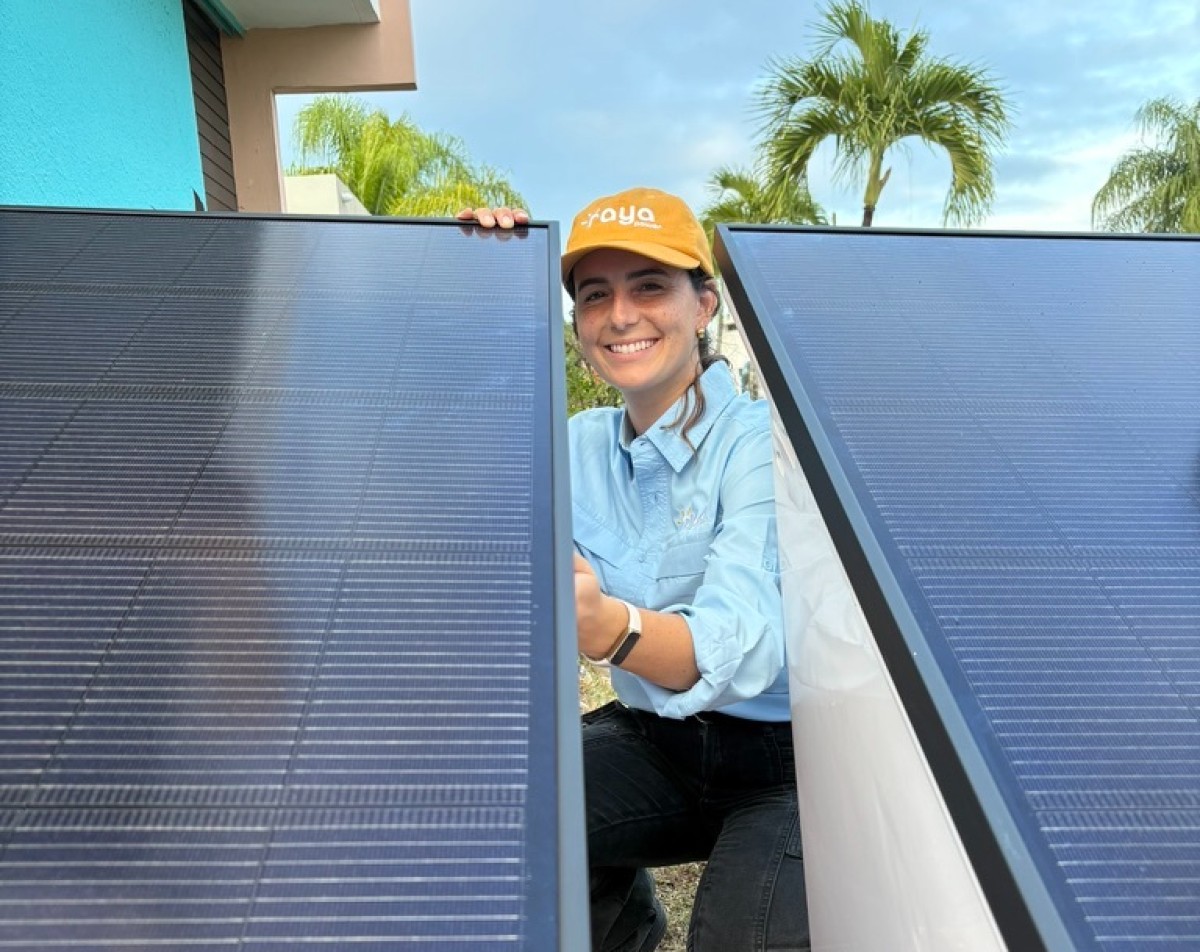
NEW YORK – In September 2017, when Hurricane Maria hit Puerto RicoNicole González worked as engineer on the Mars “Rover” (exploratory robot) at NASA’s Jet Propulsion Laboratory in California.
However, like many other Puerto Ricans residing in the United States, the physical border did not translate into emotional distance.
González tried to communicate with his relatives in the southern area of the island on multiple occasions.but it wasn’t until two weeks later that he finally succeeded.
“I was quite used to losing contact for 24 hours, the odd thing, when you’re out there (in the diaspora) and you expect to hear that everyone is okay. But The days went by and I didn’t hear anything.Well, one begins to imagine. I was following the radio trying to see any information possible; images coming out (on networks). While waiting to hear from my loved onesI was seeing everything that was happening in Puerto Rico, the electric reality that people were experiencing… When I finally heard from them, I found out that they were all in a house, my grandfather’s, where there was a generator (electricity) that could cover everything. With that and candles they survived. “My grandmother charged her cell phone with the car battery,” González said in an interview with El Diario.
That experience marked a before and after in the life of the Puerto Rican.
“I saw how people adapt creatively. But I thought how was it possible for me to see all this incredible technology in my work; We could have a Mars Rover running for 20 years, but we couldn’t keep the lights on for Puerto Rico. Those two realities did not enter my head. How were those two things possible,” he contrasted.
Aware that She became an engineer “to help people solve problems”decided to refocus his career to contribute to the solution of the energy crisis on the island.
González, raised between Virginia and Puerto Rico, decided that the community would be part of her purpose as an engineer.
“That’s when I changed my career a little to focus on product design. How I design with communities; how I could work on a solution, because the technology already existed. Generation, how did we make that technology reach people; how do we make that technology reach those who need it most. Is it a design problem? Is it an execution problem?” González, now 32 years old, reflected at the time.
Raya Strength, a solar energy company created by women
Armed with a master’s degree in Impact Engineering Design from Stanford University In the aforementioned state, he decided to create, together with Meghan Wood, a Renewable Energy graduate at the same institution, the “startup” “Raya Strength”, with headquarters in San Francisco.
The goal: create affordable solar energy systems primarily for homes whose roofs are not structured for panels.
“I met Megan at a wedding. We were in Mexico… They had asked me if my family was from Puerto Rico. ‘You have a lot of blackouts’ (they told me) and that something should be done about it. I started giving my odd speech about how we have so much sun and so many blackouts, and why don’t we go and put solar panels on top of all the roofs that exist on the island to generate our own energy. One person told me: ‘Instead of telling me, you should be talking to The ‘solar woman’. They introduced me to her and the next day we talked for two or three hours straight; we talked about how we could democratize solar energy and bring that solution to more people,” said the Puerto Rican, also co-founder of PROXIM8, an organization that promotes the economic inclusion of marginalized communities in Latin America.
By January of last year, the businesswomen had closed the first round of investment.
“We entered two programs in Puerto Rico: Parallel18, which they have two acceleration programs for startups…We ran with that last year and other support in the ecosystem of companies in San Juan and also non-profit organizations. We developed several prototypes (of systems) until we reached the design that one sees today. We arrived at that design more or less in May of last year to manufacture it and make a pilot (program) of that specific technology,” the engineer detailed about the process to create the product.
In November 2025, installations of solar energy systems began, three of these in San Juan. Raya Strength develops and monitors other equipment in California, New York and Colorado.
“In San Juan, one of the houses belongs to a family of five who say that now, when they go out, they don’t have to worry about losing $1,000 in purchases because the refrigerator will continue running if there is a blackout,” González said.
For the installation of solar panels in homes in Puerto Rico, compliance with rigorous structural requirements is required to guarantee safety and durability of the systems. Companies must make evaluations to ensure that the units can withstand the load of the plates. If this is not the case, the systems cannot be installed.
The peculiarity of the Raya Strength product is that it can be placed in the patio of the homecontrary to traditional photovoltaic panels that are located on the roof.
“The quality of the plates is the same, because we use plates that already exist on the market. We do not develop new plates. This technology is already very mature. The quality will be the same. The biggest difference is going to be the installation at home. A traditional program, someone is going to come and try to put those plates on your ceiling. If there is no option to put those plates on the roof, because you do not have the structural roof or for some other structural reason, they normally disqualify you and stop the process right there. That’s where we come in. People who cannot be served through these means have the opportunity to put a system in their backyard with our integration,” the expert explained.
The surface of the panels measures 12 × 5 feet and can be installed in just a few hours.
González added that, although they are not exactly portable, they are more manageable systems than regular ones.
“We don’t call it portable, because the system stays in place and works from there, but it can be emptied and dismantled and moved to another place if necessary and the person is going to move. It is a system that stays with you, not the house,” he specified.
In terms of energy capacity, it can cover several basic items in a home in the middle of a blackout.
“It has batteries. The initial system that we have in the pilot program right now is three plates of 450 kilowatts each and a 2.5 kilowatt hour battery. What can cover you is the refrigerator 24 hours; charging the cell phone, basic things. You can also run a small air (conditioning)… They can be basic appliances in the kitchen… They can be running something in the refrigerator, something else in the kitchen and also charge the cell phone, for example… The idea is that whatever is more critical at home for you, you can run it (keep active),” he mentioned.
The Raya Strength product is designed to be more accessible through a direct purchase model with loan options and not in leases or power purchase agreements (PPA). The system has an approximate total cost of $6,790. Purchase requires an initial refundable deposit of $ninety nine. The minimum monthly payment would be $60.
“It’s something we thought about from the beginning… You can expect to save between $50 to $80 each month with what you are generating with our system and that is what you put towards the payment of the system… You can get native financing with cooperatives where they offer a fairly large window in terms of credit and that are very accessible and then access Raya. Eventually, we want to work on a model in which we ourselves offer a subscription contract of $50 dollars and everything else you are saving, what you generate each month…”, he advanced.
“It’s the same as financing a loan. You go, they give you the check, you buy the system and then you pay that loan over time. The system is yours, but you pay little by little with what you save each month and you are not going to see a negative difference or that at the moment you have to have $1,000 dollars to pay,” the Puerto Rican added.
The former NASA employee clarified that the system does not participate in the net metering program under which credits are offered on the bill that subscribers in Puerto Rico pay to LUMA Strength for excess energy generated and sent to the network.
“Our system is a self-consumption system… We are not doing net metering, which means that you do not have to pay to do net metering; you do not have to think about whether you are saving by sending energy back to LUMA (Strength)… In our case it is simply that you generate energy and use it, and all that you are generating and using directly from our system is what you do not have to pay to the electricity grid. So by reducing what you are consuming, that is where you are saving,” he contrasted.
Selected for “Bravo Enterprise Fellowship”
These women’s project was selected last March for the “Bravo Enterprise Fellowship” grant.
The initiative, promoted by the Bravo Family Foundation in reference to the name of the influential Puerto Rican private equity businessman, seeks to support prominent industrialists of Puerto Rican descent in the expansion of their companies to national and global markets.
For the first time, this year, the investment and mentoring initiative expanded the eligibility criteria to include Puerto Rican entrepreneurs residing in New York and Miami. As part of the fellowship, participants receive direct investment and hands-on mentoring from investors in the Foundation’s networks and global private equity firm.
González described it as an honor to have been selected along with Wood.
“It is a huge honor to be recognized and we have a mission well aligned with what the foundation is doing in trying to promote solutions and talents in Puerto Rico to respond to the unique problems of Puerto Rico and beyond that as well; create global solutions,” he indicated.
He added that, as part of the advice, “they are constantly helping us how to present ourselves as a company to the world in the best way and how to work on our business model and how to make our technology reach more people in the most efficient way. All these channels help us a lot.”
Reflecting on the path in the sciences that has led her to the place she is now, González acknowledged that it has not been easy.
“Coming from engineering and a career within traditional industries, I have known very well what it is like to be the only woman in the room.; “Being the only woman trying to do something different from what exists, but it inspires me even more to do what we are doing to be an example for girls and for everyone who wants to think differently and create solutions for the problems in the world,” she said.
González acknowledged that his time at NASA added m More credibility to their work and weapons to battle against prejudices including gender and origin.
“I think being there opened my eyes to where technology could take us… incredible minds working on problems to try to make the impossible possible. We have a phrase, ‘Dare mighty issues’, that has always been key for me. If we do not dream big and about things that do not exist, they do not even have the possibility of beginning to exist.. That was always in my heart. I also believe that it gave me a foundation in excellence and rigor in engineering work…Excellence in technical work has always been very important to have. Beyond all that it gave me a positive mark. People know that I had bases at NASA and they take me more seriously. Being a woman, Latina, and my family being from Puerto Rico, people don’t always take it as positive marks, and having NASA as part of my resume has definitely helped me enter rooms and conversations where I wouldn’t have been taken seriously if I didn’t have that experience,” she said.
Keep reading:
- DOE has not yet responded to Congressional summons for cancellation of funds for solar panels in Puerto Rico
- (Video interview) Jennifer Granholm, former DOE secretary, questions cancellation of federal funds for solar panels in Puerto Rico
- Almost 200 organizations in Puerto Rico and the US ask the DOE to restore $350 million in federal funds for solar panels
- Increase in the affordable electricity rate in Puerto Rico does not surprise IEEFA expert