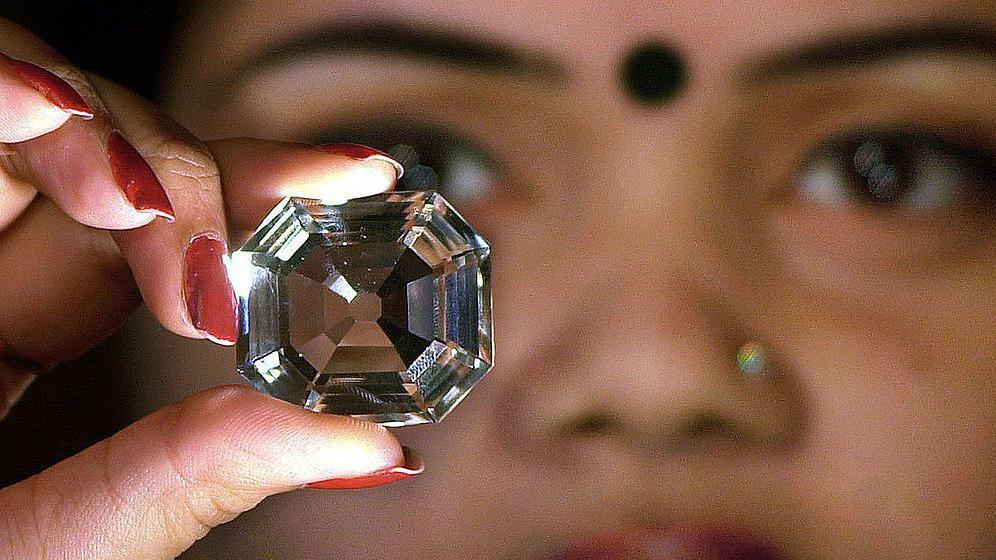
New York Mayor Zohran Mamdani said on Wednesday that if he had the opportunity, he would ask King Charles III, who was visiting the American city, to return the Koh-i-Noor diamond to India.
This diamond has been part of the British Crown Jewels since 1849, after the annexation of the Punjab region by Great Britain.
India maintains that the diamond was stolen and has repeatedly demanded its return.
In 2023, when Charles III ascended the throne after the death of Elizabeth II, the Queen Mother’s crown, in which the Koh-i-Noor diamond is mounted, was not used as in other coronations.
At the time it was reported that the UK wanted to avoid diplomatic problems with India.
Pakistan, Afghanistan and Iran have also claimed ownership of the diamond in the past.
Although it is not the most perfect and is far from the largest in the world, its history has made it one of the most famous and controversial.
a mysterious stone
It is impossible to know when or where the Koh-i-Noor was found, although there are several theories and myths about its origins.
Some say it is Syamantaka, the legendary gem with magical powers from stories. Bhagavata Purana of Krishna, one of the most popular gods of the Hindu pantheon.
This was recorded by the British Theo Metcalfe in the official history of the Koh-i-Noor that he was ordered to compile in Delhi in 1849, noting that, according to tradition, “this diamond was found during the life of Krishna.”
What is known with certainty is that it does not come from a mine, since Indian diamonds were found in alluvial deposits in dry river beds.
And although today it is found along with 2,800 other precious stones among the British Crown Jewels in the Tower of London, it has not always been there.
The precious gem has not only been passed down from generation to generation between powerful families, but it has been stolen, fought over, and has gone through all kinds of vicissitudes over the centuries.
mountain of light
Its splendor was so seductive that in 1635 it adorned the throne of the Mughal ruler Shah Jahan among a brilliant sea of rubies, emeralds and pearls.
The Mughals retained power in India for a century after the throne was created, but soon the country’s vast riches became famous and the Persian ruler Nader Shah decided to invade.
In 1739, he entered Delhi and stole a treasure so large that it is said that it took 700 elephants, 4,000 camels and 12,000 horses to transport it. The throne was part of his loot.
For the first time, the dazzling diamond left India and acquired its name: Koh-i-Noor, which means “Mountain of Light” in Persian.
Shah removed the diamond from the throne and placed it in a bracelet he carried with him.
For decades, the diamond stood in the place that would become Afghanistan, passed from ruler to ruler in blood-soaked battles.
In 1813 he was back in India.
There it also went through a myriad of dynasties, invaders and leaders who established their kingdoms and fiefdoms in those lands.
It eventually came into the hands of Sikh Maharaja Ranjit Singh, who founded the Sikh Empire in Punjab in 1799.
And then, the British arrived.
a gift
The British East India Company, which had conquered swaths of India, heard a rumor about a priceless treasure called Koh-i-Noor and set out to obtain it.
For Lord Dalhousie, the overall governor of India, the diamond was the supreme symbol of power.
He wanted Britain to possess the Jewel of India as well as the country itself.
Lord Dalhousie’s opportunity finally came in 1849.
There are conflicting versions about the circumstances under which the diamond was given, including that it was a gift.
But Anita Anand, a BBC journalist and co-author of a book about Koh-i-Noor, said: “I haven’t heard of many ‘gifts’ being given at the point of the bayonet.”
Ranjit Singh had died in 1839 and, despite signing treaties of friendship with him, the British began deploying troops around the border, Anand said.
This was considered an act of open aggression by the Sikhs and a war broke out from which the British emerged victorious.
Under the condition that they would have “full authority to direct and control all affairs in all departments of the State”, they insisted on leaving the maharaja on the throne, who by then, after the death of his brother, was Duleep Tell, Ranjit’s youngest son.
The imprisonment of his mother, the regent, sparked a second Anglo-Sikh war, which left the once-mighty empire completely weakened, with a boy king at its head.
At just 10 years old, Duleep Singh handed over his kingdom and the Koh-i-Noor to the British.
The famous diamond was “taken to England in honor of the glory of our arms in India, as one of the splendid trophies of our military valor,” according to the newspaper. Delhi Gazette.
Prince Albert had it recut in the 1850s to make it shine brighter and it was placed in a brooch for Queen Victoria.
Finally, it was incorporated into the crown of Queen Mother Elizabeth, being worn at the accession of George VI to the throne in 1937.
The gem made a public appearance in 2002 on top of the coffin of the Queen Mother, mother of Elizabeth II.
However, it was the death of Elizabeth II in 2022 that made the Koh-i-Noor regain relevance. There were many Indians who asked that he be returned to their country.
Thus, in 2023, the Queen Mother’s crown with the precious diamond was not used at the coronation of Charles III and Camilla, probably to avoid a diplomatic incident.
Keep reading:
* Carlos III and Camila honor the victims of 9/11 in New York in a historic visit marked by memory and diplomacy
* Trump highlights the leadership of King Charles III against the Democratic Party
* Historic speech by Charles III at the Capitol: a call to reconcile with the US.
click here to read more stories from BBC Data Mundo.
Subscribe here to our new newsletter to receive a selection of the best content of the week every Friday.
You can also follow us on YouTube, instagram, TikTok,X, Facebook and in the new WhatsApp channel.
And remember that you can receive notifications in our app. Download the latest version and activate them.
- Why Marie Antoinette, the most controversial queen in history, was so hated
- The amazing story of Marie Antoinette’s splendid clock
- Why the American War of Independence cost Marie Antoinette her head
- The incredible story of the “lost king of France” whose DNA solved a 200-year-old mystery
- The secret history of the Palace of Versailles that few visitors know