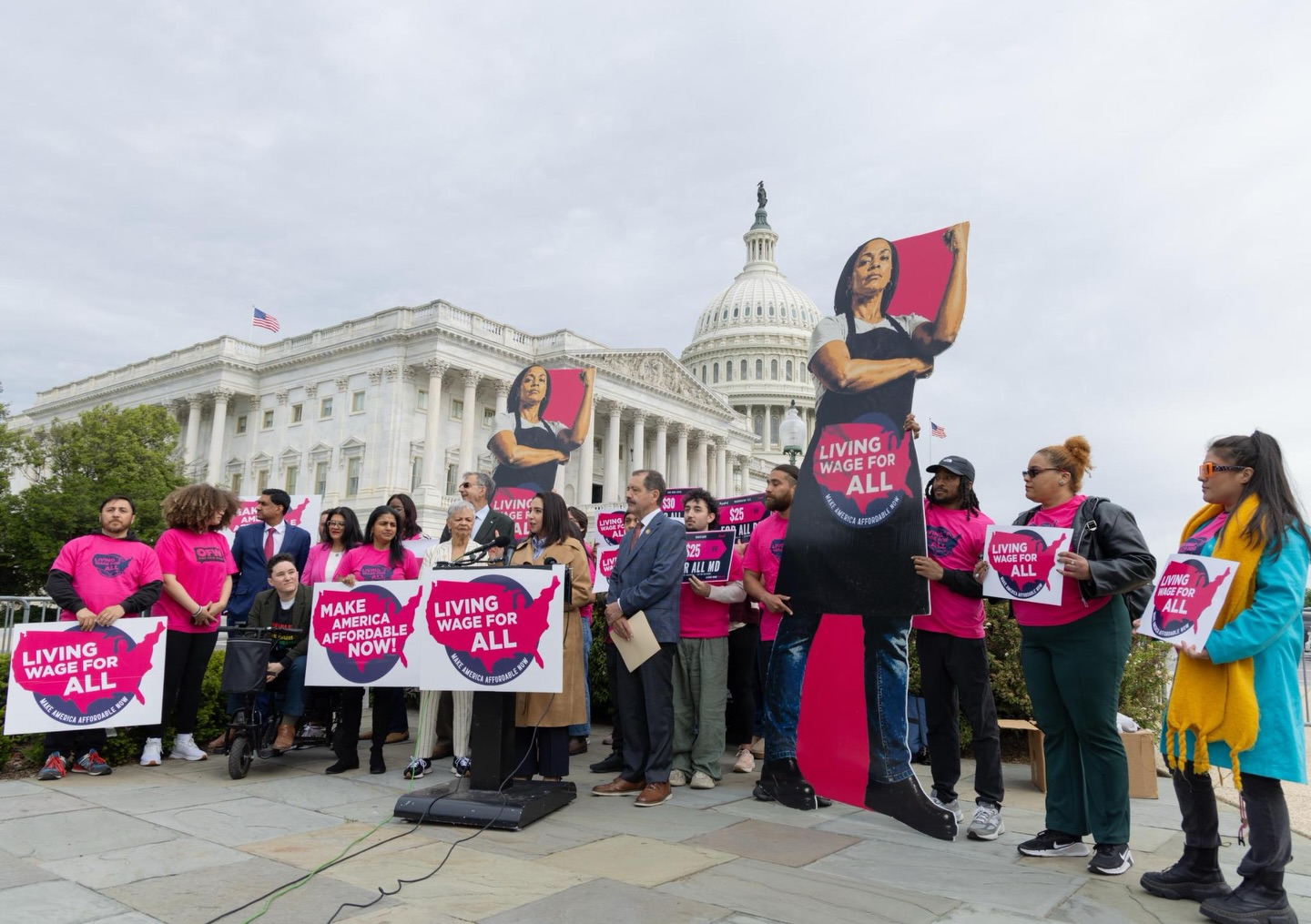
NEW YORK – Some 20 organizations supported the “Living Wage for All Law” legislation (“Living Wage for All Act”) that seeks increase the federal minimum wage to $25 an hourwhile would eliminate all salaries below that figure.
The bill, presented this Wednesday by Democratic representatives Delia Ramírez (Illinois) and Analilia Mejia (New Jersey) It seeks to give way to a staggered increase under which large companies would have to reach the goal faster than small ones.
The bill requires large employers to reach $25 by 2031.while the smallest ones must complete the transition by 2038.
The piece of legislation also integrates a mechanism to keep the minimum wage aligned with typical salaries in the economy as a whole. As the economy grows and wages increase, the minimum wage must increase, the congresswomen explained.
The measure would eliminate all wages below the minimum without exception. This includes tipped workers, young people, and those who struggle with disabilities.
Since 2009, the federal minimum wage has remained at $7.25 an hour.
Given the increase in the cost of living, which includes food, housing, services such as child care and medical care, the promoters of the legislation propose establishing a “minimum wage based on economic reality”.
The congresswomen’s effort, joined by more than 20 Democrats, is in line with several campaigns to establish minimum payments of $25, $27 and $30 in states and cities such as California, Illinois, New York, Washington DC and Maryland.
At the press conference yesterday to announce the bill, Ramírez stated that the current minimum wage is not a decent one.
“Growing up, I saw my immigrant parents and neighbors working multiple minimum wage jobs just to survive. Today, companies are reporting record profits while working people are struggling to survive. The minimum wage is not a living wage. That’s not fair. If we want to address the affordability crisis, we must also address the wage crisis. Congress must stop pleasing kings and the whims of those who aspire to be kings, and start working for working people,” said the congresswoman.
Mejía, for his part, argued that while the costs of housing, gasoline and food have skyrocketed, the federal minimum wage has not increased since 2009.
“This is unacceptable. No one who works full time should have a hard time surviving.. We need an economy that reflects the realities of 2026, not one stagnant for more than a decade. That is why I led the fight to raise New Jersey’s minimum wage to $15 per hour,” declared the representative who was recently sworn into the House.
“This bill would transform millions of lives, ensuring that working people earn a truly living wage, instead of being forced to choose between putting food on the table and taking care of their health. Americans deserve an economy that works for everyone, not just the billionaire class,” he anticipated.
At present, HR8555 has 25 co-sponsors.
He also received the support of organizations such as Nationwide Association for the Advancement of Colored Of us (NAACP), American Federation of Teachers (AFT), Nationwide Training Association (NEA), RetailWholesale and Division Retailer Union (RWDSU), Middle for Well-liked Democracy, PolicyLink, One Sleek Wage, SEIU Worldwide, Our Revolution, Alliance for a Neutral appropriate Society, Patriotic Millionaires, Nationwide City League, Novel Disabled South, Keystone Progress Training Fund, Voices for Progress (V4P), Chicago Training Advocacy Cooperative, Trabajadores Unidos Workers United and Nationwide Organization for Girls (NOW).
April VerrettInternational President of the SEIU, considered the measure a “powerful testimony of the movement led by workers” to impose a new minimum standard to achieve living wages.
“While The affordability crisis continues to suffocate working familiesSEIU members are organizing and fighting to set even higher standards across the country. “We applaud Representative Ramírez for this bold $25 per hour proposal: an important step forward driven by workers who demand the money, power and respect they have earned,” he declared.
For Saru Jayaraman, president of One Sleek Wage, the new call for a living wage is a national evolution of the “Fight for $15” campaign.
“Across the country—From California to the Midwest to the East Coast—workers are organizing to demand $25 and $30because that is what it takes to be able to live. Surveys show that this initiative is not only popular, but necessary. And the expression “for all” means exactly that: no worker is left behind. This is what it looks like when politics begins to catch up to reality; and when democracy creates genuine improvements in people’s lives, they become tangible. A living wage is the way we make that promise a reality,” considered the activist.
Stuart Appelbaum, president of the RWDSU, asserted that affordability goes hand in hand with the salary people receive.
“This bill aims to hold corporate America accountable. and prevent billionaires, large corporations — like Amazon — and CEOs from evading responsibility by blaming other factors for an affordability crisis that they themselves are helping to aggravate. As prices rise and corporate profits grow, workers continue to be paid poverty wages rather than a true living wage. This must change if we really take dignity and equity in our economy seriously,” he stated.
Kimberly Johnson, director of government relations for NEA, said the country needs the legislation like never before.
“As the Trump Administration takes more and more resources away from the classrooms and communities that need them most—all while giving greater power and privilege to the wealthy and well-connected—workers across our country need this legislation now more than ever,” the leader said.
For her colleague, Becky Pringle, president of the entity, a living wage will translate into better care and services for students.
“By paying educators and educational support professionals a living wage, they will get the respect, competitive salaries, and support they deserve to equip their students with the skills they need to fulfill their dreams. At a time of enormous income and wealth inequality, the National Education Association is proud to stand up for the working class and support the Living Wage for All Act. An investment in workers is an investment in the future of public schools and our nation.”
Ramírez’s press office confirmed to El Diario that The provisions of the law would apply to territories such as Puerto Rico.
On the island, organizations such as Build Another Agreement and La Tejedora supported the legislative initiative.
According to information on the US Department of Labor (DOL) website, The federal minimum wage of $7.25 per hour applies in Puerto Rico for employees covered by the Fair Labor Standards Act (FLSA). However, the Puerto Rico Minimum Wage Law (Law 47-2021) established a higher minimum wage of $10.50 per hour, which came into effect on July 1, 2024. Because it is higher than the federal one, it prevails.
Keep reading:
- NJ Representative, Analilia Mejía, takes oath of office in Congress with call for workers to rise up
- Proposal for a minimum payment of $30 per hour for NYC workers fuels an alliance between various business chambers
- Democratic representative to lead bill to limit DHS’s ability to detain migrants
- Delia Ramírez says it is time to stop American crypto investors who evade federal taxes under Law 22 in Puerto Rico